Originally posted on Facebook on December 20, 2024.
Two brothers. Two writing styles. A world of words waiting to be discovered. In Brothers from Different Fathers, Haibun’s sprawling prose meets Haiku’s sharp precision in a creative clash that becomes a lifelong bond. This story celebrates the beauty of collaboration, the poetry of life, and the power of family.
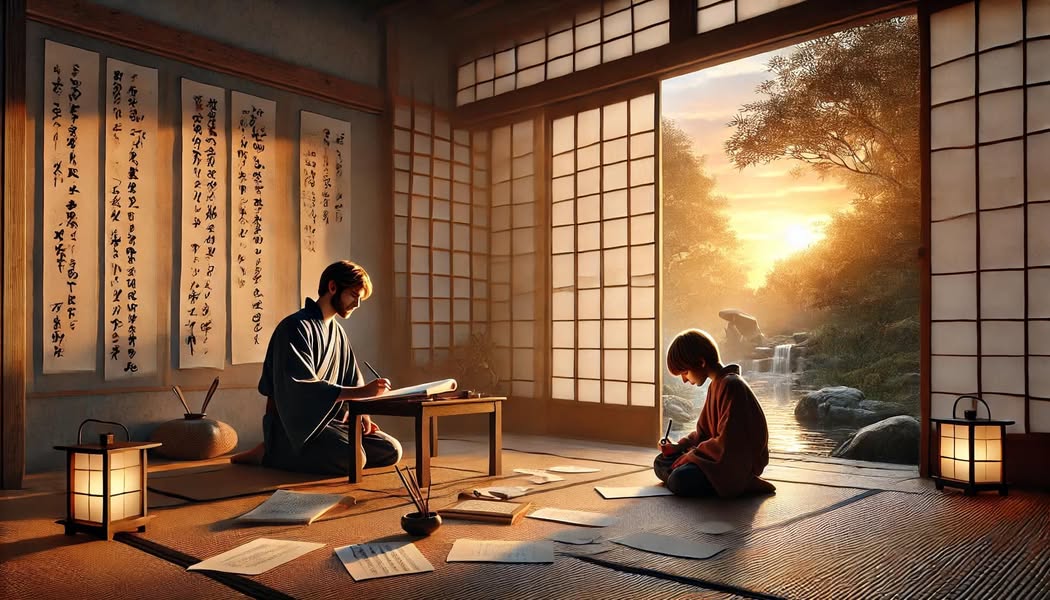
In a small attic studio, the two half-brothers sat, their worlds separated by a rickety wooden desk. Haibun, the older of the two, relished his sprawling paragraphs, weaving stories that lingered like fog on a cool morning. Haiku, the younger, thrived in brevity, his words as sharp as frost on a windowpane. They argued often—about structure, about style, about the purpose of words.
“You need to let the moment breathe,” Haibun would say, leaning back in his creaky chair.
Haiku would smirk, flipping a notebook shut. “You take so long to make your point, it loses all meaning.”
But on some evenings, as the sun bled into the horizon, their differences melted into laughter. Together, they would create something neither could achieve alone. Haibun’s expansive storytelling anchored Haiku’s fleeting sparks, and Haiku’s precision sharpened Haibun’s wandering thoughts.
Words stretch, then shatter—
one long path and one brief flame
meet under the stars. (Haiku)
The brothers had come to writing differently. Haibun’s love for prose was shaped by their mother, who told them bedtime stories that seemed to stretch for hours, each word painting the walls of their imagination. Haiku, on the other hand, found his craft in silence. Long walks in the woods, the crunch of leaves underfoot, and the distant cry of a loon taught him to condense the world into syllables.
“Why do you always have to cut everything down?” Haibun asked one day, slamming his notebook shut. “Not everything has to fit in the palm of your hand.”
Haiku shrugged, twirling a pencil. “And not everything needs to sprawl like ivy on a wall.”
Vine climbs the old fence—
wind whispers a single truth,
too soft to be heard. (Haiku)
Despite their squabbles, the brothers had one unbreakable bond: their shared love for words. On rainy afternoons, they’d sit together, challenging each other to describe the same scene in their unique styles. A thunderstorm for Haibun became a sweeping tale of fury and release, while for Haiku, it was:
Sky splits in anger—
earth holds her breath again. (Monoku)
Haibun grinned, scribbling a note in the margin. “I’ll give you that one. But next time, try telling the whole story.”
Haiku rolled his eyes. “Or maybe you could learn to leave something unsaid.”
One summer evening, the brothers decided to collaborate on a piece for a local literary contest. It was an experiment, merging their styles into one seamless work. Haibun handled the exposition, crafting a story of a lone fisherman who finds an abandoned boat drifting in the mist. Haiku, however, layered in different forms of Japanese poetry to bring life to the scenes.
Net torn to shreds, cold—
the empty boat laughs at him. (Senryu)
For a reflective moment, Haiku wove a mondō, a dialogue in verse, between the fisherman and the sea:
“Why do you take so much?”
“Because you leave so little.” (Mondō)
For the emotional climax, Haiku wrote a tanka, evoking the fisherman’s nostalgia for his lost family:
Shadows by the shore—
children once danced in the waves.
Now only footprints
lead to the water’s edge,
where memories drown in salt. (Tanka)
Finally, the brothers added a rhythmic chōka to close the piece, its alternating lines capturing the ebb and flow of the story:
Mist hugs the shoreline
as the sun begins to set.
A lone gull cries out,
its shadow skimming the waves.
The fisherman waits,dreaming of the net he lost.
Wind whispers his name—
but the sea keeps all its gifts. (Chōka)
The night before the deadline, they read their work aloud, their voices blending in perfect harmony.
“You know,” Haibun said, “I think we might actually win this thing.”
Haiku smirked. “Don’t get used to it. I’m still the better writer.”
Haibun chuckled, leaning back in his chair. “Sure. As long as you remember who taught you everything you know.”
Two voices converge—
one echoes into the dark,
the other cuts through silence. (Sedōka)
When their work won first prize, the judges called it “an innovative fusion of form and voice.” Haibun smiled as he held up the certificate.
“See? Together, we’re unstoppable.”
Haiku grinned, pocketing the prize money. “Sure. But don’t get used to it.”
Evening fades to night—
two stars trace their separate paths,
briefly converging. (Haiku)
Years later, their paths diverged. Haibun became a celebrated novelist, his stories sprawling across pages, praised for their depth and texture. Haiku traveled the world, his tiny verses appearing on subway walls, in pocket-sized anthologies, and as whispers in the wind. Still, they kept in touch, trading letters and challenges.
“Write me a story in fifty words,” Haiku once wrote.
Haibun replied, “Write me a haiku about regret.”
Their words became a bridge, spanning the miles and the years.
Old desk by the fire—
two pens rest side by side now,
both out of ink. (Haiku)
When they reunited in the autumn of their lives, they found themselves back in the attic studio. The rickety desk still stood, and the sun bled into the horizon as it always had. They laughed about their youthful arguments and worked on one last piece together, a story-poem about brothers and the beauty of words.
In the amber light
a page turns, then another—
leaves fall in silence. (Haiku)
(I am deeply grateful to my brother Hendrik, who lived in and taught English in Japan for several years, for his invaluable help in composing the haiku featured in this story. His expertise made this work possible.)
If you enjoyed this story
A personal memory and a story about two brothers show two ways of bringing prose and haiku together.
Leave a Reply