Preface
This is a longer, more reflective story, built around ideas that may ask you to pause while reading. It is, by design, a difficult read — not because of the language, but because of the concepts it explores. It rewards patience and reflection rather than speed.
Humans have always tried to hold time still. We called a year 365 days because Earth circled the Sun. We carved each day into 24 hours because Egyptians once split daylight and darkness into twelves. We broke those hours into 60 minutes, then 60 seconds, because Babylonians loved their base-sixty math. Later, we chained the second to the oscillations of cesium atoms, believing we had mastered it.
Yet Earth herself refuses to keep still. The Moon drags at our seas, slowing the planet’s rotation. Glaciers melt and shift her balance. Earthquakes shave microseconds from the day. The axis wobbles across millennia. Even our finest atomic clocks must bow to corrections.
This story explores what happens when human precision meets the larger, older rhythms already at work: tides, moonlight, blossoms, soil. The concepts may feel abstract at times, but that difficulty is part of the design. Like the protagonist, the reader is asked to listen differently—and to wonder whether time is not one line, but many voices.
⸻
The Story
He built the machine to measure drift. Not to conquer time, not to strut among centuries, only to stop the small lies that clocks tell when left to themselves. Satellites slip. Ground arrays wobble on their foundations; humidity breathes against quartz; cesium sings but not always in the same key. He had devoted a career to stitching those errors shut. If time could be made airtight, he thought, people could finally relax into it.
In the test chamber, the machine bristled with antennas and a toroidal emitter ring—a fixed, donut-shaped array around a hollow where a human body might fit if its owner were foolish. The ring’s field didn’t throw you through time so much as retune how your body met it.
He was not foolish. He was merely thorough. The bench team had agreed: a human inside would amplify the calibration data. Biological clocks are noisy; the device could sample the mismatch, correct for it, and finally tame the last decimals between celestial and cellular time.
He clipped on a field tag at his belt—insurance, a tether to the lab’s monitors—and stepped into the hollow carrying nothing but a notebook, a pencil and the most precise wristwatch he owned.
“Three breaths,” said a voice over the intercom. “Stand easy on the second. We’ll fire on the third.”
On the third, the machine let go of being a machine. The ring became a loop without inside or outside, and his stomach flipped as if he were both falling and being pulled sideways through a corridor no one had ever noticed in the weave of the world.
⸻
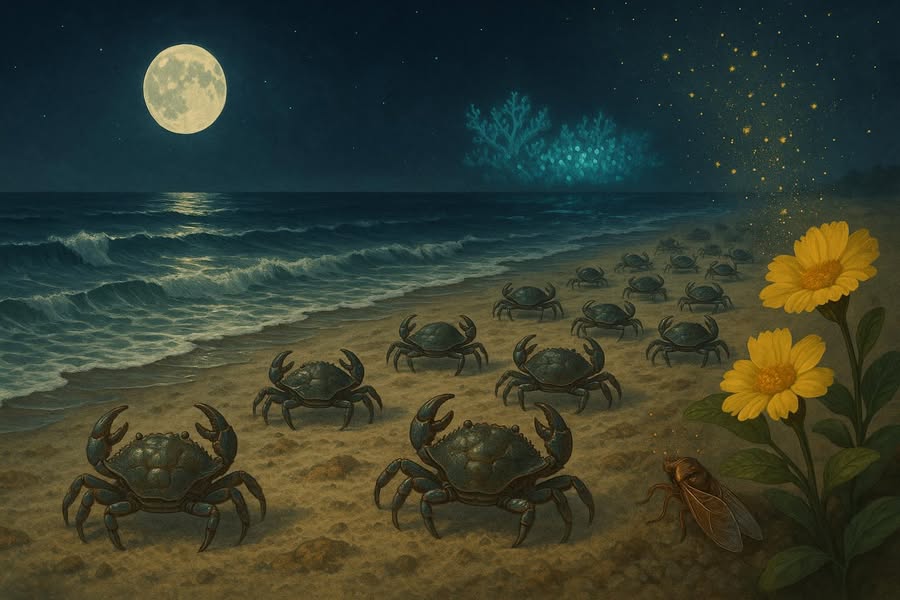
He landed on wet sand. The sea inhaled, then exhaled, withdrawing with a velvet hiss to reveal dark ribs of sand. From the shallow pools, crabs emerged in formation. They raised their claws not in threat but as if answering a roll call only they could hear.
“You are early,” one rasped.
He looked at his watch. “No,” he said, voice catching. “I’m exact.”
The crab tapped its shell. “Not your toy of ticks. This is the thirty-third retreat.”
He closed his notebook slowly. Spoken language? Cadence matched to tide position.
“We breathe by them,” said the crab. “We are not counting. We are arriving.”
The sideways tug returned. He was pulled under.
⸻
He was in water, but he did not drown. Breath came anyway, thick and cool, as if the water itself had decided to humour his lungs.
Around him, the architecture of a reef rose like a city lit by festival lanterns. Corals burned with their own small moons. Fish cut neon angles. And the reef itself seemed to stir, its living surface shimmering with pulses that cascaded like speech.
He thought of how whole reefs spawned as if on signal, thousands releasing life in the same hour when the moon reached a certain edge. Here the light moved with that same certainty, stepping like phases of borrowed moonlight.
“I’ll return tomorrow,” he said.
The reef flickered with laughter, a ripple of light racing across its living face. Then, as if the reef wished to make its answer personal, one of its luminous creatures drifted nearer, carrying the pattern forward. A band of pale light crawled down its side in deliberate steps.
“Tomorrow?” it flashed. “Waning third or waxing first?”
The distinction hit like cold. His field tag pulsed once, desperately off-beat, as if trying to call a tomorrow of its own.
⸻
The sideways tug took him into a grove. Blossoms opened in precise bars of sunlight, releasing pollen that drifted like golden breath. The dust tingled and became air in his lungs.
“To rush,” they said, rustling softly in his chest, “is to arrive before the season.”
He hid his watch behind his back. “How long is a sentence?” he asked.
A branch lowered; a flower released a sigh of gold. “Long,” it said in noon. “Short,” it added in twilight.
⸻
Darkness. Soil filled his mouth, ears, nose. Panic seized him until he realised he could breathe if he remembered to breathe differently.
“A cycle is seventeen years,” thrummed the earth. “That is our second, our minute, our hour.”
The tones repeated in a hymn no single life could complete. He stopped flailing. He was in a masterclass of patience. His field tag buzzed faintly, then went silent, as if conceding it could not keep up.
⸻
He returned to the strand. The crabs assembled again. “I want to listen until the wanting is less,” he confessed.
“Then stop summoning,” said the crab.
But he tried anyway. He set his beacon to broadcast—a congress of clocks. He laid his watch facedown on the sand beside the dim field tag and waited.
They came. The reef shimmered with phases of moonlight. The blossoms exhaled at noon. The soil thrummed its long chord. The crabs stood in rows, certain they were neither early nor late.
“You are six retreats late,” said the crab.
“He is moons too early,” flashed the reef.
“Half a sentence,” sighed the blossoms.
“Opening bars,” sang the soil.
The watch on the sand was the most ridiculous object he had ever owned.
He left it there. “I cannot make one time out of yours. I thought you were rhythms, not voices. I was wrong.”
“Yes,” they answered, each in their way.
“Then why did we never hear you?” he asked.
“Because you are quick and loud,” said the crab.
“Because you were not inside the light,” said the reef.
“Because you arrived before the season,” breathed the blossoms.
“Because you were not born to our bars,” sang the soil.
He stood small and grateful. “What should I do?”
“Arrive when the water breathes in,” said the crab.
“Speak with two edges,” flashed the reef.
“Wait for the bar of noon,” breathed the blossoms.
“Return when the ground itself hums your name,” sang the soil.
He laughed, not in despair but in joy.
⸻
The sideways tug took him gently back. The lab’s intercom crackled: his name, a curse, a demand for status.
“I’m late,” he said. “And very early.”
They swarmed him with blankets and water. They asked what he had seen. He thought of the crab’s patience, the reef’s moonlight grammar, the blossoms’ gold, the soil’s hymn.
“It works,” he said at last. “It hears what we never learned to hear.”
“What do we do with that?” someone asked.
“Learn,” he said. “And stop summoning.”
⸻
Further Reading
I don’t normally provide a “further reading” list for my fictional pieces, but in this case, if you are interested in pursuing some of the scientific and philosophical ideas behind the story, these are easy to find:
• National Institute of General Medical Sciences, “Circadian Rhythms Fact Sheet.”
• Russell G. Foster & Leon Kreitzman, Rhythms of Life (2004).
• John D. Palmer, The Living Clock (2002).
• J. Davenport, Animal Timing (1997).
• John D. Palmer, The Biological Rhythms and Clocks of Intertidal Animals (1995).
• O. Levy et al., “Light-Responsive Cryptochromes from Coral Acropora millepora,” Science (2007).
• Stefano Mancuso & Alessandra Viola, Brilliant Green (2015).
• Daniel Chamovitz, What a Plant Knows (2012).
• Monica Gagliano et al., “Experience teaches plants to learn faster and forget slower,” Oecologia (2016).
• Gene Kritsky, Periodical Cicadas: The Plague and the Puzzle (2004).
• Stephen J. Gould, The Lying Stones of Marrakech (1999).
• J.T. Fraser, Of Time, Passion, and Knowledge (1987).
• Carlo Rovelli, The Order of Time (2018).
Leave a Reply