The kitchen was too bright that morning, the kind of light that rattled nerves instead of lifting them.
Eli, nine years old, sat at the table with his mop of dark hair falling into his eyes, knees bouncing, hands flapping in quick, sharp bursts. His lips hummed a thin tune only he seemed to know, a sound both fragile and insistent.
“Settle down,” Mark said, though the words came out softer than he meant. He rubbed his own hands together under the table, a nervous trick he’d learned to hide decades ago. Back then, no one gave it a name. You were fidgety. You were odd. You just had to stop.
They’d known something was different since preschool—when the noise of circle time sent Eli bolting for the hallway and he lined up crayons instead of using them. Speech therapy had helped a little, occupational therapy too, though transitions still set him off. Weighted blankets gave brief relief at night, but mornings like this always slipped through their hands.
Eli’s hum rose a notch, the flap of his hands faster now. The spoon on the table clattered, sharp against the hum. Mark’s jaw tightened. Diane glanced at him from the stove, the look in her eyes carrying the same old question: why do you push so hard?
Mark swallowed against it. He wanted to say he understood. That he’d once rocked in bed the same way, or pressed his cheek against the cool wall to quiet the storm inside. But the words never left his mouth. They sat heavy, locked down where he kept everything he couldn’t name.
“Please, Eli,” he tried again, this time gentler. The boy’s hands slowed, just a little. Mark exhaled, though he wasn’t sure if it was relief or guilt.
⸻
Diane slid the frying pan off the burner and turned, spatula still in hand.
“Mark,” she said quietly, nodding toward their son, “we need to try something different.”
He bristled before she even said it. He knew that tone, the careful step she always took before suggesting another tool, another therapy, another way of easing what couldn’t be eased.
“What now?” His voice had an edge, sharper than he intended.
“There’s this chair,” she said. “The child development clinic just got one in. It wraps around them—gives pressure, like a hug. They say it’s helped other kids.”
Mark almost laughed, though nothing felt funny. “A chair? Diane, I never had a special chair. I learned to cope without some inflatable gadget.”
Eli was humming again, tapping his spoon against the rim of the bowl, eyes flicking back and forth as if watching something only he could see. The sound rattled through the room.
Diane’s gaze held steady. “And how did that feel, Mark? Coping without help?”
He opened his mouth, closed it. The hum rose higher. He rubbed his palms against his thighs, hard, as if friction alone could scrub the truth away.
⸻
Mark thought that would be the end of it, another suggestion dropped into the pile of things they couldn’t afford or didn’t need. But Diane, quiet as ever, made the call anyway.
Two weeks later, the delivery truck left the box at the edge of the porch, stamped with words Mark refused to read. Diane tore it open with the practiced urgency of someone who’d already made up her mind.
Mark stood back, arms folded, as she dragged the thing inside—a bulky seat with smooth fabric sides and hidden seams. It looked more like a piece of modern furniture than a medical contraption, which only made him more suspicious.
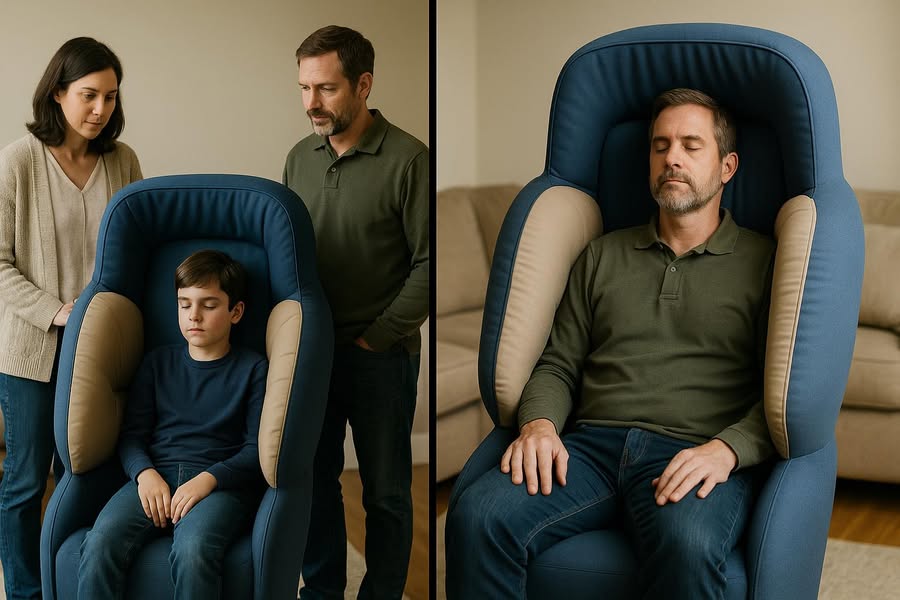
Eli hovered by the doorway, eyes wide, humming low in his throat. He pressed his hands against his temples as Diane inflated the inner walls with a quiet hiss. The chair swelled into shape, round and sturdy, its arms curving like an embrace.
“Eli,” Diane coaxed, her voice as soft as the fabric. “Want to try?”
He shook his head, a small, sharp movement, but his eyes never left it.
Mark almost said, Leave him be. He doesn’t need this. But the words snagged in his chest. He watched Eli’s fingers flutter, watched the way the boy shifted from foot to foot, unable to anchor himself. Something in the sight pulled at an old memory—nights spent rocking in the dark, the only comfort a pillow clutched so tight it left marks on his arms.
Diane knelt. “Just for a minute,” she whispered, and guided their son closer.
Eli climbed in cautiously, knees bent, back stiff. Diane pressed a button, and the chair’s sides tightened with a slow, even pressure. Mark held his breath.
The humming faltered, then faded. Eli’s shoulders dropped, his hands stilled. He leaned back, eyelids fluttering, as if the whole world had finally loosened its grip.
Mark’s own shoulders gave way, slumping as if a rope had been cut. His hands, always curled, spread flat against his thighs. For the first time in years, he let out a breath he hadn’t realized he was holding.
⸻
Later that night the house was still, except for the tick of the clock in the hallway. Eli had gone to bed without protest, curled calm and heavy under the blanket. Diane had disappeared upstairs with a book.
Mark lingered in the living room, the new chair shadowed in the corner. It looked harmless now, its rounded shape almost inviting. Still, he circled it like a stranger unsure of his welcome.
He lowered himself slowly, as if it might betray him. The fabric was firm, cool beneath his hands. For a moment he just sat there, rigid, staring at the dark window. Then, almost against his will, he pressed the button.
The chair exhaled, then drew in, the sides inflating until they pressed close against his ribs, his arms, his thighs. The embrace was steady, unyielding yet kind. He swallowed hard. His breath slowed.
Memories flickered—nights clutching a pillow until his knuckles ached, afternoons hiding in the stairwell at school, rocking against the wall to keep the noise at bay. He had never told anyone, not even Diane. You didn’t admit to things like that. You just learned to cope.
She must have guessed, though. After Eli’s diagnosis, Diane had looked at him differently, not unkindly. The doctors had mentioned family tendencies, but Mark had cut them off before they could say more. He wasn’t ready then.
Now, wrapped in the steady pressure, he felt the years fall away. His shoulders sagged, the tightness in his chest easing with each slow breath. The stillness startled him. Comfort, even more.
In the hush of the living room, Mark closed his eyes and thought: Maybe it isn’t too late. Maybe I don’t have to keep pretending. Yet even as the thought came, another shadow followed—what if he couldn’t keep this up? What if softness made him weak? He sat there caught between the old fight and the new possibility, uncertain which part of him would win.
⸻
The next morning, sunlight edged through the curtains. Eli sat cross-legged on the carpet, tapping the corner of a toy car against the floor in steady rhythm. Diane moved quietly in the kitchen, her presence steady as always.
Mark hesitated at the doorway, then stepped in. He glanced at the chair, its fabric smooth again, waiting. Eli’s eyes flicked toward it, then back to his toy.
“Did you like it?” Mark asked, his voice rough with sleep.
Eli nodded once, a small, sure gesture. The boy’s fingers slowed their tapping, as if the memory of pressure still held him steady.
Diane looked up, a question in her eyes. Mark gave a short breath—half laugh, half sigh. “I tried it too,” he admitted. “Last night.”
Something softened in her face, a warmth he hadn’t let himself seek in a long time. “And?”
He shook his head, searching for words. “It was… easier. Quieter. Like someone finally—” He stopped, fighting the instinct to dismiss it, to call it foolish. The words came halting, reluctant but true. “Like someone finally said it was all right to stop fighting.”
Diane set the kettle down. Eli leaned into the chair then, as if drawn by invisible threads, settling into its embrace without prompting.
Mark watched, not with the old tension, but with something closer to relief. Maybe this was their second chance—not just for Eli to find calm, but for him to stop hiding the boy he once was.
He crossed the room, laid a hand on the chair’s side, and let himself feel its steady hold. Relief came, yes, but threaded with unease. Could he really change after all these years? He wasn’t sure. But for the first time, he wanted to try.
⸻
Author’s Note
This story was sparked by a single line in the South Korean drama Extraordinary Attorney Woo. The series became a worldwide phenomenon in 2022, breaking viewership records in Korea and reaching #1 on Netflix’s global charts. It was a reminder that stories about autism, told with warmth and respect, could resonate far beyond their borders.
Later, I researched the OTO Hugging Chair in France, created as a sensory refuge for people on the autism spectrum. The chair’s embrace struck me as both practical and symbolic: a reminder that comfort is not indulgence, but a form of dignity.
Bringing those two sparks together, I imagined a family caught between recognition and denial, finding a second chance through compassion. The chair in this story is real. So are the struggles and silences of living with autism, both diagnosed and undiagnosed. My hope is that the telling honours them—not as curiosities or clichés, but as lives deserving of patience, respect, and the possibility of change.
⸻
Sources & References
• Extraordinary Attorney Woo — South Korean drama series, 2022.
• OTO Hugging Chair — designed by Alexia Audrain, France, winner of the James Dyson Award (2021).
• Temple Grandin — researcher and autism advocate, creator of the original “hug machine.”
• PubMed: OTO Hugging Chair feasibility study (2024) — reporting benefits for children with autism in emotional regulation and anxiety reduction.
Leave a Reply