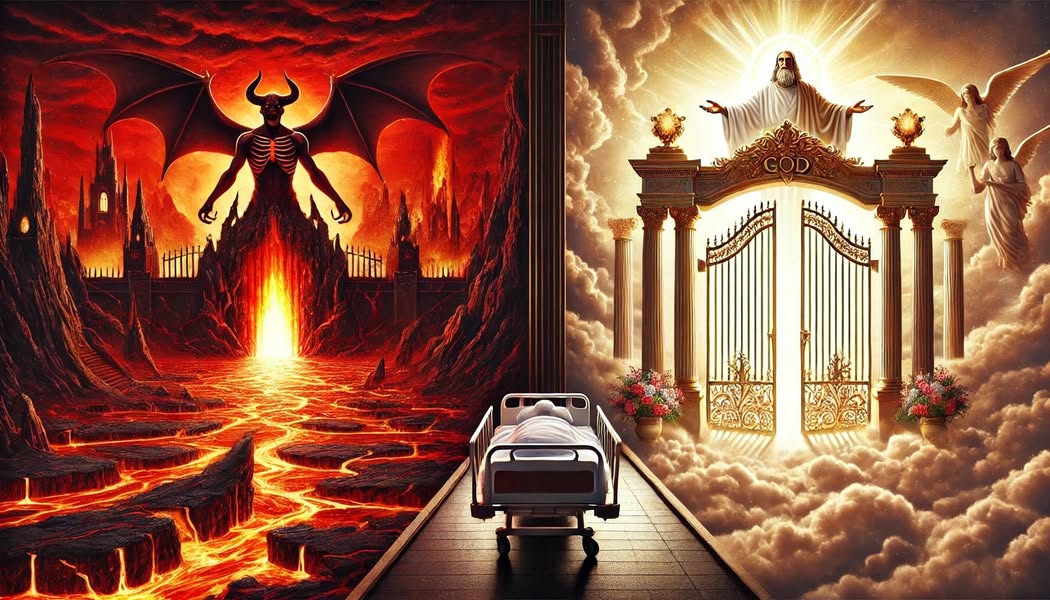
Life rarely grants do-overs—but sometimes, it does.
Introduction:
In the quiet of a hospital room, a dying man wrestles with the great unknowns—heaven, hell, judgment, and redemption. Doubt and hope wage war within him. Is his fate sealed?
Unfinished
He had spent his last months thinking about this. Death. The great mystery. The place beyond the veil.
It hadn’t come as a surprise—his body had been failing for a long time, each day his illness tightening its grip around him a little more, a slow-closing fist. The doctors had spoken in careful, measured tones, offering timelines they couldn’t guarantee. Friends and family had visited, speaking softer than they once did, as if volume alone could keep him from slipping away.
But in the quiet hours, when the lights in his room dimmed and the hum of the machines blurred into the stillness, he had done what he always did—he thought. He read. He searched for answers on his iPad.
Not in the frantic way of a man desperate for salvation, but with the same methodical curiosity that had shaped his life. What happens next? It was a question that had haunted humanity since the beginning of self-awareness, yet no one really knew.
He had looked at the Christian idea of judgment—the weight of sin, the promise of grace. Would he stand before God and have his life measured? Would mercy extend beyond his mistakes, or would the sins he carried, the ones too great to speak aloud, tip the scales against him?
Islam spoke of God’s mercy, greater than His wrath. Would repentance matter now, at this late hour, when time had run out?
Judaism spoke of Teshuva—returning to righteousness through sincere repentance. But could one ever find peace making amends to the long dead? He’d wronged people. Not through violence or betrayal, but through absence, silence, indifference. Some of them were gone now, unreachable by phone, letter, or tearful apology. And yet, their shadows lingered—quiet witnesses to what he might have said, had he known then what he knew now.
Hinduism and Buddhism offered a different view—karma, reincarnation, cycles upon cycles of existence until the necessary lessons are learned. Had he already walked this road before? Would he wake again in another life, bearing the weight of this one? Or was this it—the final stop?
And then there was the Bahá’í Faith, which spoke of an afterlife as a continuation of the soul’s journey—not as reward or punishment, but as movement toward or away from God. Had he been moving in the right direction, or had he spent his life walking backwards?
None of it had given him certainty.
He had hoped, foolishly, that as death crept closer, something would click—that some deep, unshakable truth would reveal itself. That he would know, with clarity, what came next.
But the truth had never come. Only questions. And now, he was here. Wherever here was. And he still didn’t know. What did he need to do? Could he do anything at all? Or was it already too late?
He felt as if the verdict had already been read—his fate sealed with wax and twine—and now he was merely awaiting the sentence to be carried out. The world around him was still and silent, as if it too held its breath in judgment. In that suffocating quiet, a single fear pulsed through him: it was truly over.
All the roads he had walked, all the choices he had made, had led here, and nothing he could do now would ever unwrite them.
His thoughts churned as he searched his memories for something—anything—he could cling to, some moment he could have chosen differently. But every recollection rose up like a spectre with accusing eyes. Each past decision loomed over him as an unanswered question, burning without resolution: What if he’d chosen differently? What if he’d been kinder, more honest, braver?
It was far too late to know. The past was a locked door, and he had thrown away the key.
Now, at the yawning edge of death, he felt trapped in the aftermath of his own life. The weight of his mistakes pressed down on him, and he wondered if this crushing remorse was all that awaited him beyond the grave.
And so, in the silence, he waited—adrift on a sea of doubts, anchored by a single, delicate hope.
His story wasn’t finished after all. Not yet.
It hung in the balance, unresolved, like a breath held in the expectant hush before the dawn.
He did not know if redemption was possible, if he would ever find peace, or if he was doomed to linger in the weight of his regrets. But as he drifted in the unknown, one thought held him there, anchoring him to something beyond despair: This is not the end. It couldn’t be. His story was unfinished, and as long as the question remained unanswered, then perhaps—just perhaps—there was still time to write a different ending.
Author’s question: This story explored the tension between regret and the possibility of grace, a question many face in their final moments. What do you believe comes? Please comment.
Special thanks to my editor Hendrik de Pagter
Leave a Reply