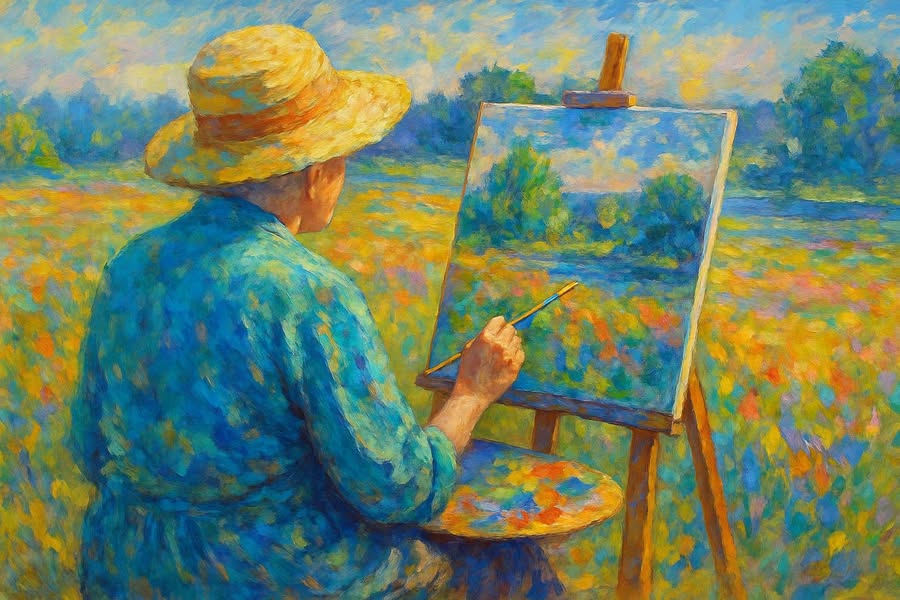
Second Chance: Reclaiming a dream deferred, not for fame, but for fulfillment.
—
Agnes Dalton had always known how to keep quiet.
Quiet while nursing babies in the night.
Quiet when George came home sore from the mill.
Quiet when the art scholarship came in the post, and she folded it—creased once, then again—before slipping it behind the sugar canister in the kitchen. Out of sight, out of reach.
The scholarship offer had come just weeks before her high school graduation. George had bought a second-hand Ford and was already calling her “my girl.” The church ladies were watching.
That was 1959. Her mother called it a “nice little opportunity.” Her father said he wouldn’t pay for a girl to live alone in Toronto. So she stayed.
She married. She baked. She raised three children, lost one, then raised the others harder. She did what women did in those years—crocheted afghans, sewed colourful quilted bedspreads, joined bake sales, painted quietly when no one was around. No one ever asked her about the scholarship. She never brought it up.
George had passed quietly in his sleep, the same week the garden irises bloomed. She never remarried. There wasn’t much need for two companions when one had filled the room so completely.
Decades passed.
Then one morning, at eighty-four, she found herself at the kitchen table again—her tea cooling beside a paint-splattered rag, and a half-finished canvas of a field she had never seen but somehow knew by heart.
The painting—done in soft oils on stretched linen—showed a windswept field beneath a lavender dusk. Her style leaned pastoral, impressionistic. Nothing wild. Just tender strokes that spoke more to memory than ambition.
Her granddaughter Mara, a whirlwind of soft hoodies and opinions, caught sight of the painting on her way to class. She stopped, stared, then snapped a photo on her phone before Agnes could say a word.
—
A week later, Mara came back with news.
“Granny, it’s gone a little viral.”
Agnes blinked. “Gone what?”
“People are liking your painting. A lot. I posted it to this Instagram page I made for you. You’ve got over 300 followers. Someone messaged asking if it’s for sale.”
Agnes’s instinct was to tell her no. That the painting wasn’t for anyone. But she didn’t say it. She just sipped her lukewarm tea and looked away.
That night, she found herself digging through the old keepsake box in the linen closet. There it was, still folded behind an envelope of pressed violets: the scholarship letter. She unfolded it slowly, the paper gone brittle at the seams.
Dear Miss Dalton, we are pleased to offer you admission to the Ontario College of Art’s Fall 1959 program…
Her fingers trembled. She put it back.
—
By spring, she’d painted four more canvases—this time in fast-drying acrylics, easier on her joints and forgiving of the occasional tremor. The colours were brighter, the strokes looser, but the style remained unmistakably hers: soft, impressionistic, and steeped in recollection.
It echoed the way some of the late Impressionists had evolved—Monet in his gardens, Morisot in her final years—favouring memory and emotion over precision. Agnes no longer tried to copy what she saw, only what she remembered.
Mara kept posting. A local artist collective shared one of the pieces. Then a gallery in Kingston sent an email.
“We think your grandmother’s work is extraordinary,” it read. “Would she consider exhibiting?”
They called her a “hidden treasure.” A “rural visionary.” Mara nearly dropped her phone. She showed Agnes the message while holding a cold Pop-Tart and wearing one slipper.
But Agnes hesitated.
“I don’t want to be anyone’s rediscovered genius,” she muttered, wiping her brushes. “I’m not a story. I’m just… old.”
“You’re not just anything,” Mara said. Then quieter, almost to herself, “You paint like you’ve got ghosts to settle.”
Still, Agnes had her doubts. What did it mean to be seen now, after all this time? When she was younger, visibility had felt like risk. At her age, it felt like exposure.
She told Mara she’d think about it. Then, without a word, she took the bus to Kingston to see the gallery herself.
—
It was sleek. White walls. Hard light. The current exhibit featured mixed media from students barely older than Mara—raw and restless and hungry.
She stood in a corner and watched a group of young women unpack their frustrations in paint and thread. One piece was titled Inherited Silence.
She stood there for a long time.
When she returned home, she called the gallery. She said she would exhibit, but only on one condition: they had to feature five other older women artists in the same show. Women who, like her, had once set their dreams aside—for children, husbands, aging parents, war, illness, or simply because no one told them they were allowed to dream out loud.
There was a pause.
“That would change the whole concept,” said the curator.
Agnes nodded. “Then change it.”
Silence. Then: “Let me speak to the director.”
—
Agnes began reaching out.
Some names came from Mara’s artist circles. Others came from church directories, community centers, old friends.
Elaine painted bold prairie abstracts between chemotherapy rounds.
Minh, a Vietnamese refugee, had sketched in charcoal for decades but never once shown her work.
Ruth-Anne painted biblical scenes with a surrealist tilt and wild colours that unsettled her pastor.
Barb, who once taught art at a rural school until the budget was cut, painted the same maple tree every season for twenty years—like a hymn.
And then there was Joanie.
Joanie refused at first. “I’m not a real artist,” she said. “I just paint to keep the noise down.”
Agnes visited her house. Looked at the rows of dust-covered canvases in the basement. “You’re more real than half the men hanging in that gallery,” she said.
Joanie didn’t answer. But the next week, she dropped off three framed pieces at the town library with a note:
If you still want them, they’re yours.
The show would be called Almost.
—
Opening night arrived in early June.
Mara wore her best thrifted blazer and read a short introduction to a small but weepy crowd. Many in the audience were older women—some with tears, some with nodding silence—because they understood. The years lost. The chances not taken. The art that lived quietly in attic corners.
Mara began:
“Tonight, you’ll see paintings by six women.
By my grandmother, Agnes Dalton, who never stopped painting—just stopped showing anyone.
By Elaine, who paints between hospital visits.
By Joanie, who spent forty years painting in secret.
By Minh, who fled war and found colour again in her seventies.
By Ruth-Anne, whose visions blend scripture and dreams.
And by Barb, who painted a single maple tree, season after season, like a prayer.
They were almost forgotten. Tonight, they are not.”
When Agnes’s name was called, she didn’t step forward. She simply stood, straight-backed and serene, her hands clasped like she was holding something delicate.
A local reporter asked if this was the start of a new career.
Agnes smiled faintly.
“No,” she said. “Just a proper ending.”
—
Leave a Reply