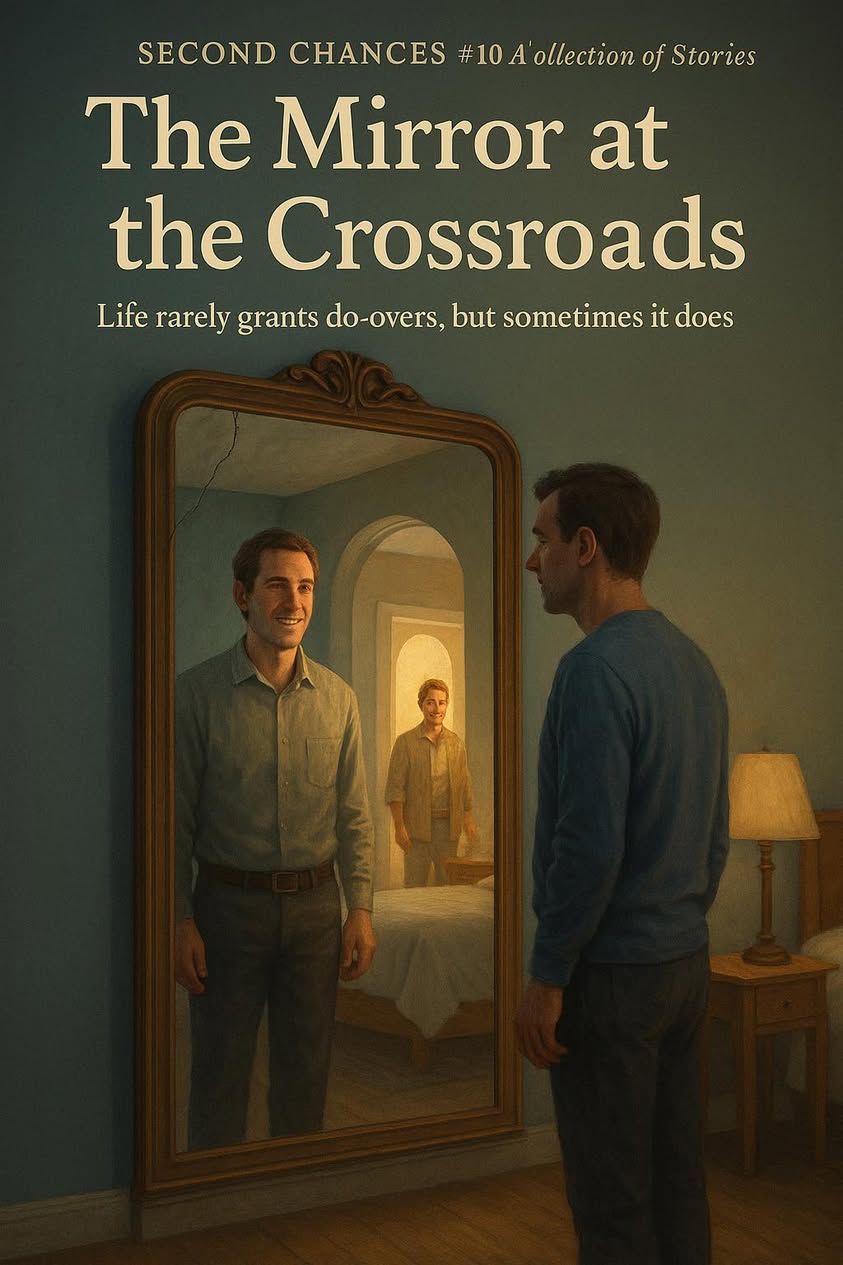
Life rarely grants do-overs, but sometimes it does.
He found it at a roadside yard sale just west of Perth—one of those dusty setups where old windows leaned against tree trunks and everything smelled faintly of diesel and rain.
The mirror was tall, maybe six feet, its wooden frame a tarnished bronze colour with curling details that looked hand-worked. A hairline crack ran through the top left corner, like it had taken one truth too many.
He didn’t know why but it unsettled him. Not in any theatrical way—just enough to make his pulse skip.
He was thinking of leaving when the seller called out.
“You sure you want that one?”
Thomas paused, hand tentatively reaching for his jacket pocket.
The man looked like someone who’d run out of things to sell years ago and just kept going. He squinted, scratched the back of his scrawny neck.
“It’s… persistent.”
Thomas gave a half-smile. “So am I.”
The seller shrugged, as if that settled it.
Twenty dollars later, the mirror was wedged awkwardly into the back of his sedan, wrapped in an old moving blanket. No receipt, just cash to avoid the cost of GST.
He told himself he’d find a spot for it in the guest room. He didn’t have guests, but the lie made it easier to ignore the weight in his chest as he drove home.
He’d told himself the mirror would go in the spare room with the dusty leftover furniture and unopened boxes, like everything else from the last few years that didn’t fit anymore.
But when he carried it upstairs, he paused outside his bedroom door. The far wall was bare—had been since Dana left. She’d taken her dresser mirror with her, though the outline of it still lingered faintly on the wall like a ghost.
He wasn’t sure why he hesitated. Maybe because it felt too personal to face his own reflection every morning.
Or maybe because he hadn’t wanted to see what she’d left behind.
« What the heck » he said out loud.
He leaned the mirror gently against the wall opposite the bed. No hooks. No screws. Just a folded towel under one edge to keep it steady.
He didn’t clean it. Didn’t look into it for long. Just undressed, got into bed, pulled the comforter up, turned out the light, and stared at the ceiling until the numbers on the alarm clock blurred.
He woke just after midnight with the uneasy feeling that someone had said his name.
Not loudly. Not urgently. Just enough to stir him from a shallow, dreamless sleep.
The room was dim. No streetlight outside. Just the faint LED glow of the clock and the darker shape of the mirror across from the bed.
He looked toward it, turned on the bedside lamp.
At first, it showed what it should: the foot of the bed, the dresser, his own outline beneath the covers.
Then the light shifted.
The mirror brightened—softly, warmly. Like sunlight bouncing off late-afternoon walls. The room in the reflection was not his. The walls were sage green. A framed painting of a lake hung above the bed. And there he was—himself, but younger, lighter somehow. And beside him, still asleep, lay Elise.
He hadn’t seen her in over a decade. Not since Toronto. Not since the job offer in Halifax—the one that would’ve taken him east and her west. They had split gently, with the kind of restraint that almost made it worse.
In the mirror, the other Thomas stirred, glanced toward him, and smiled. Just slightly. Not smug. Not surprised. Just… calm.
Then the mirror darkened.
Back to the room he knew. The blank wall. The worn bed. His own breath catching in his throat.
Thomas didn’t sleep after that one.
He sat on the edge of the bed with the lamp on, staring at the floor like it might give him answers.
A painter. That’s what he’d been in the second reflection.
He hadn’t touched a brush in twenty-three years. Not since he sold off the last of his supplies to pay for a second-hand car when Dana got pregnant. That version of him—the one who kept painting—had thinner hair, deeper laugh lines, eyes that looked like they’d seen something worth seeing.
Thomas touched his own jaw. It felt unfamiliar.
The mirror stood still again. Just glass. Just silence.
The next day, his own home felt stage-lit—like a set piece someone had designed to imitate the past, but not too closely.
The kitchen was too quiet. The fridge buzzed like a bug caught in a lamp. The fruit on the counter looked untouched—not fresh, not rotting, just… waiting.
He turned on the radio. Old jazz. Something brushed against memory—he used to play that while painting. Not in this life. The one in the mirror.
He opened the fridge. Closed it. Didn’t eat.
Later, at the post office, the clerk asked how his weekend was. He paused too long before answering.
“It was… quiet.”
That evening, he stood in front of the mirror before it changed.
He practiced smiling. Practiced scowling. Looked for something in his own eyes—recognition, accusation, anything.
All he saw was a man trying to remember who he used to be. Or who he might have been.
He didn’t want to go to bed. Didn’t want to wake up.
What he wanted was to step forward. Reach through the glass. Feel paint on his fingers. Hear Elise’s voice again. Be someone who had chosen differently.
Not better. Just… more alive.
The next night, the mirror changed early—11:48 p.m.
Thomas had been waiting, though he told himself he wasn’t. He sat in the armchair by the window, a cup of tea gone cold beside him.
This time, the change wasn’t light or temperature. It was silence.
A perfect stillness filled the room. Even the hum of the refrigerator downstairs seemed to pause.
The mirror brightened.
But it didn’t show an alternate version of him.
It showed a door.
An arched wooden doorway, half-open, with soft light spilling through. Beyond it, the painter’s studio—the one with sunlight and unfinished canvases and a woman’s voice just out of frame.
His breath caught.
He stood up. Crossed the room.
In the mirror, his reflection didn’t follow.
He stepped closer. Just one more pace, and the door in the mirror would align with where he stood.
The studio waited. It looked warm. Lived-in. Free of ghosts.
Behind him, his own bedroom sat in quiet disrepair. A loose sock on the floor. An unopened bill on the dresser. A life.
He reached out. One fingertip brushed the glass—and the surface rippled. Not like water. Like breath on cold glass. It welcomed him.
For a moment, he imagined the scent of turpentine. The sound of jazz. The ease of painting without regret.
He could walk through. Live there. Stay.
But something stopped him.
Not fear.
Memory.
Of Dana’s hand on his back the night they lost their child. Of the silence that followed—not sharp, but slow and spreading. A silence that settled into their home like dust, until even their laughter sounded borrowed.
Of her laugh when they first moved in. Of the years after—the dull ones, the quiet ones, the ones that taught him how to stay when staying wasn’t easy.
And Elise—he’d loved her. Maybe still did. But that life hadn’t been lived. It had been imagined.
He stepped back.
The mirror pulsed once, gently.
And then the door closed.
He woke with the sunrise.
The mirror was still there. Just glass now. Dull and heavy. It reflected the room exactly as it was.
He didn’t cover it. Didn’t throw it away.
He left it standing.
Not as a portal.
Not as a promise.
But as a reminder.
He brewed coffee. Opened a window. Let in the morning air. The world outside hadn’t changed. His hands still ached. The house still echoed in places it hadn’t before.
But the weight in his chest felt different.
He had been offered second chances.
Real ones, maybe. Or just reflections of longing dressed up as truth.
He didn’t take them.
Not because he didn’t want them.
But because they weren’t his to take.
Leave a Reply