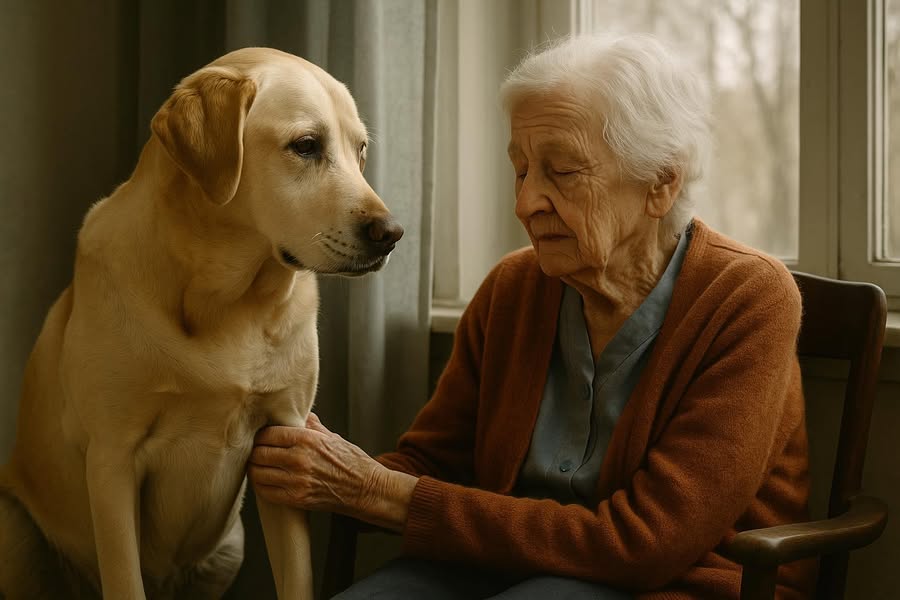
Life rarely grants do-overs, but sometimes it does.
I wasn’t born in a cage. That’s the first thing I want you to know. I was born in a kitchen drawer lined with an old towel, in a little house with hydrangeas out front and the smell of burnt toast most mornings. My first memory is of a voice—soft and cracked, like the vinyl records she played. That voice named me Charlie.
Mabel was mine, from the moment I could wobble across the floor and nose into her slipper. She talked to me like I was someone, not something.
“Charlie, you’ve got more sense than half the folks I know,” she’d say, especially when I growled at the television or barked at the mailman.
At night, when she settled into her armchair with a mug of cocoa and her knitting on her lap, I curled into the crook of her legs and we’d drift off together, the old radio humming lullabies in the background.
I’m what they call a Lab mix—mostly yellow Labrador, with a bit of shepherd in the ears and something else in the tail, no one ever figured out what. My vet, Dr. Singh, used to joke I had the personality of a golden retriever and the joints of a hound dog.
“Built for devotion,” she’d say, patting my ribs, “but not for stairs.”
Mabel took that to heart. After my second birthday, she stopped letting me chase the squirrels too hard and started adding those chewable glucosamine tablets to my kibble.
We kept a good routine—walks after lunch, gentle ball throws in the backyard, and every spring, a trip to the vet. Mabel always wore her Sunday clothes to those appointments, like she was worried the doctor would judge her if my nails were too long or my weight was up. She’d fuss and fret, and I’d just lie down and thump my tail.
Then one year, we didn’t go.
Things started to change—not all at once, but like a drawer slowly left open.
First, Mabel forgot our walk. That had never happened before. She stood in the kitchen with her shoes in her hands, looking at them like they were strangers. I wagged and sat by the leash, but she just patted my head and went to make toast again, even though we’d already eaten.
I tried nudging the leash toward her feet—once, then again. She smiled but didn’t clip it on. Instead, she sat at the table and stared at the window like she was waiting for something. I sat beside her. That’s what you do when someone forgets what they were doing. You wait with them.
She called me “Buddy” one morning. I don’t mind “Buddy.” I’ve been called worse. But the way she said it—tentative, like she wasn’t sure I belonged—it made something cold settle in my chest.
Sometimes the stove stayed on. When it did, I’d bark. Not frantic, just enough to bring her back into the room. She’d frown at the kettle or the smoking pan, then laugh to herself, stroke my ears, and say, “What would I do without you?”
I didn’t know. And I didn’t want to find out.
She started to leave doors open—fridge, closet, front entrance. I learned to nudge them closed with my nose when I could, or bark if the air smelled too sharp, too wrong.
One evening, she wandered into the yard without shoes, coat, or keys. I ran circles around her, herding her gently back toward the porch like I was born for it.
She didn’t hum as much anymore. The plants by the window wilted from thirst. When she tried to water them, she’d forget which ones she’d already done, or pour too much and make a mess. I followed her around with careful paws, ready to lick up spills before they reached the rugs.
She mixed up days—asking if it was Sunday when the radio played jazz, or wondering why the mail hadn’t come when it was dark outside. I started to bark at the mailbox at the same time every afternoon, just to help anchor the rhythm.
She thought it was funny.
“My own little postman,” she’d say.
I watched her from the hallway when she stood still for too long. Not sleeping, not resting—just frozen, like her mind had wandered down a hallway without her feet. I’d trot over and press my head against her leg. Sometimes that brought her back.
Then came the bruises. Small ones on her arms, from bumping into counters she used to move around with ease. I started walking closer to her, letting her steady herself with one hand on my back.
She never called me her support dog. But she used me like one.
She stopped knitting—said her hands were “tired.” But it wasn’t her hands that forgot how the pattern went.
One day she dropped her keys and muttered,
“You’ll have to start reminding me, won’t you, Charlie?”
I licked her hand. I already had been.
When she left the front door open one windy night, I barked until the neighbour came over. After that, they started checking on her more. Whispered voices. Phone calls. Pity in their eyes.
One of them—I think it was her niece—knelt beside me and said,
“You’re looking after her, aren’t you, Charlie?”
I was trying.
One morning, men in uniforms came. They carried clipboards and spoke in soft tones. One of them knelt beside me and patted my head like I was a child. Mabel didn’t sing that morning. She just stared ahead, like she was looking through a window I couldn’t see.
They took her.
Not in a cruel way—but completely. One moment she was on the couch with a blanket over her knees, and the next she was gone, the door closing behind her with a final-sounding click.
I waited on the porch. For hours, then days. The neighbour fed me and said words I didn’t understand.
“No pets allowed where she’s going,” she said to someone on the phone.
I don’t know where that is, a place without pets. Doesn’t sound real to me.
Eventually, I ended up here—at the shelter. People came and went. Dogs barked. I didn’t. I waited.
They kept me in the quiet wing. Said I was “well-mannered,” “a senior,” “low energy”—which are all just human ways of saying “not new.” They gave me joint chews like Mabel used to. They brushed me, cleaned my ears, even took me for dental once, though I was groggy for days.
One of the staff, Marcus, would sit with me on his breaks and say,
“You’ve still got that look, Charlie. Like you’re watching the driveway.”
I was.
I thought my work was done. That I’d loved once, and that was it. But sometimes, the world circles back. Gives you a new job when you thought you were finished.
Time moved strangely. I stopped tracking it after a while. The barking faces around me changed. My legs grew stiff. My muzzle greyed. I no longer chased balls; I watched them roll and let someone else go.
The shelter was full of echoes—barking, metal bowls clanging, doors that squeaked and slammed. But I only listened for footsteps that never came.
Then came Trish.
She didn’t come to adopt. She was starting something called a visitation program—bringing older dogs like me into care homes to sit with people who missed what we gave. She looked at me and said,
“You’re calm. You’ve got history.”
She was right.
The first place we went smelled like mint and sadness. Old people sat in chairs by windows. Some of them smiled. Some stared at nothing. I didn’t know what to do, so I just sat quietly, like I always had.
Then I smelled her.
It wasn’t strong—faint, like lilacs in the wind—but it hit something in me like thunder through the floor. I turned and there she was. Thinner. Paler. Hair whiter than the snow we used to watch fall outside our front window. But her eyes… they were still searching.
I didn’t bark. I just stood and wagged once. Slowly.
She didn’t reach for me. Didn’t say my name. Just stared, her lips trembling. Trish said,
“This is Charlie. He’s a visitor,”
and tried to steer me to the next room.
But Mabel—yes, it was her—whispered, so softly I almost missed it:
“Charlie?”
My ears perked. I stepped forward.
She didn’t know her name most days, but she knew mine. That was enough. A second chance, not for remembering—but for belonging again, before the clock ran out.
The next visit, she patted my head. The one after that, she sang while brushing my ears with her fingers.
“You’re my old boy,” she said, as if the world had only just begun again.
I didn’t go home with her. That part was over. But I curled up under her chair every Tuesday and Thursday afternoon while she napped, or hummed, or stared out the window. I brought her slippers once—out of instinct. She laughed, then cried. I understood both.
One afternoon, she looked down and said,
“I think we had a house. With a blue fence. And a radio.”
I thumped my tail. She remembered the radio.
We didn’t speak the same language, but we never had to.
When she passed, they let me lie beside her for a little while. I don’t know what happens after people leave again, and I try not to guess.
But when they opened the door that day, I didn’t wait on the porch.
This time, I followed love instead of losing it.
And that—that was my second chance.
Author’s Note
The Dog Who Waited is a fictional story, but its themes are drawn from realities many families know too well.
Dementia affects not only memory, but rhythm, confidence, and connection—especially for older women living alone. Quiet changes often go unnoticed until a crisis forces intervention. In those long in-between days, what often sustains someone isn’t just a calendar or a care plan, but a presence. Something—or someone—that remembers the routine even when they can’t.
Support animals, both trained and untrained, provide more than companionship. They anchor people to the world, gently nudging them back to the familiar. Many seniors have no formal diagnosis, no family advocate, and no language left for asking. But a dog doesn’t need words. Loyalty fills in the silence.
This story is for anyone who’s witnessed a slow fading. And for the animals who waited longer than most would expect.
If you enjoyed this story
A dog tells one story from its own side. In the other, the humans are learning to listen to theirs.
Leave a Reply