Life rarely grants do-overs—but, every now and then …
This is a story of a cashier, a mother, and a mirror held up by her daughter, a story of giving a second chance—to someone else, and to oneself.
Aisle of Regret
Some lessons arrive gradually, like soft rain sinking into dry soil. Others hit suddenly—like a sharp crack of thunder, shaking you out of yourself.
Margaret hadn’t given a second thought to the thin, nervous girl at the grocery store checkout. She was tired. In a rush. Frustrated. But when her daughter came home crying later that night, something shifted.
It had been the end of a long day. Margaret had rolled her cart into the express lane at Eastgate Grocery, but the line was moving slowly. Too slowly. And her left knee ached.
At the register was a young woman—barely out of high school, by the looks of her—wearing a name tag that read Ava. Her hands trembled slightly as she tried to enter a produce code. She fumbled with a coupon. She called for help once, softly.
Margaret checked her watch. Tapped her foot.
She huffed. Her patience was slowly boiling over.
When she finally reached the register, she locked eyes with the freckle-faced girl, offered no smile, and let spill:
“Honestly, is this your first day? Maybe don’t work rush hour if you can’t keep up.”
Ava blinked. Her cheeks flushed. “I’m—I’m sorry. I’m still learning.”
Margaret stared. “Maybe they should train you better before leaving you out here on your own.”
She left with her groceries without looking back. Another minor irritation in her busy day, forgotten before the car started.
That evening, the front door opened, then closed with a sharp thud. Margaret got up from the kitchen table and found her daughter Sophie, face blotchy, blue eyes wet and glassy, sitting on the living room couch, hands clutched tightly in her lap.
“What happened, love?”
Sophie took a deep breath and tried to speak through the tremble in her voice.
“I – I messed up. I sent the wrong file to a client. My new supervisor lit into me. In front of everyone. Said I wasn’t cut out for the job. I just—I wanted to disappear.”
Margaret pulled Sophie close, arms wrapped tightly. “I’m so sorry. That’s awful.”
But as she listened—really listened—Margaret felt something curl in her gut. Something unpleasant and undeniable.
She had said nearly the same words that afternoon. To someone else’s daughter. To Ava.
She’d dismissed her, embarrassed her, made the poor girl feel small.
Now, she could see what it looked like from the other side.
That night, Margaret sat at the kitchen table long after Sophie had gone upstairs. The house was silent except for the hum of the fridge and the occasional creak of the vents.
Her tea had gone cold.
She thought about Ava’s face. How young she looked. How her voice had cracked.
She thought about Sophie. How deeply it had hurt her to be publicly humiliated. How hard she’d worked for her new role.
And then, the thought that wouldn’t leave her: What if someone had done that to Sophie? In her first week?
She already knew the answer.
She would’ve been furious.
So why wasn’t she furious with herself?
She’d made Ava feel exactly what Sophie was feeling now.
And she couldn’t leave it like that.
The next morning, Margaret returned to Eastgate Grocery.
She waited, patiently, in the longest line—Ava’s line—even though other registers were moving faster.
Ava glanced up when she saw her. Recognition, and then a hint of fear, flickered behind her wary eyes.
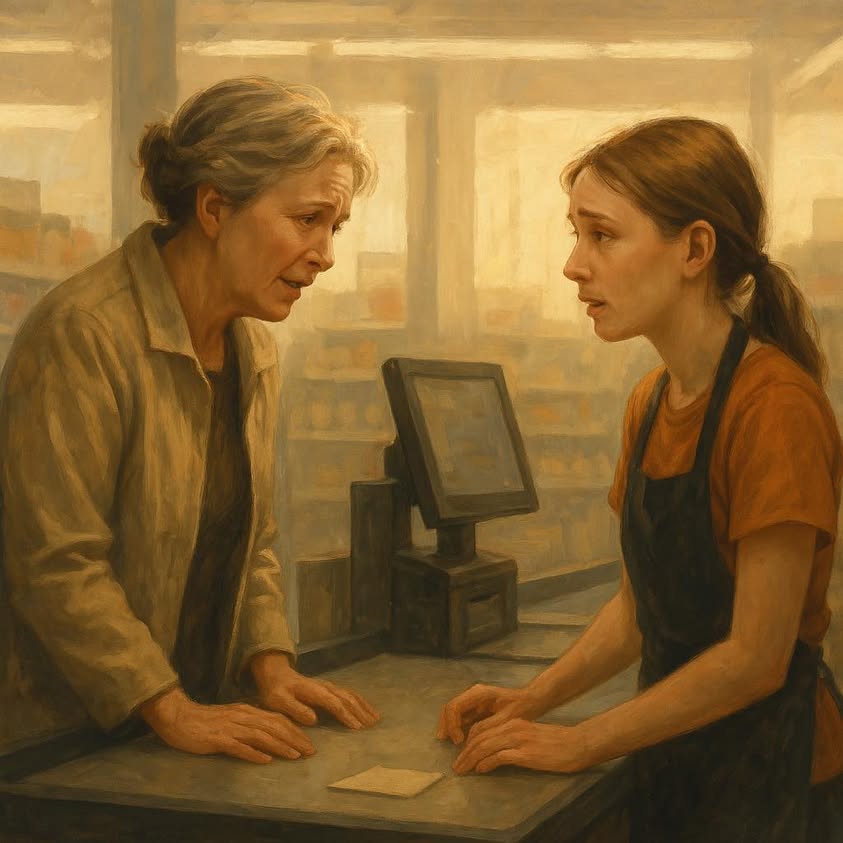
When Margaret stepped forward, she placed her hands calmly on the counter.
“You probably remember me from yesterday,” she said.
Ava nodded slowly.
“I was impatient. And rude. And I made your job harder when I should’ve made it easier.”
She took a deep breath.
“I came back to apologize.”
Ava stared, stunned. The customer behind Margaret looked up. A supervisor lingered nearby, pretending to tidy something but clearly listening.
Margaret pulled a small envelope from her coat pocket and placed it on the counter.
“I wrote you a note. It’s not much. But it’s sincere.”
She paused. “You’re doing better than you think.”
And with that, she stepped aside and left the store without waiting for a reply.
Inside the envelope: « We all start somewhere. Keep going. You’ve got this. » – Margaret
That evening, Margaret told Sophie the whole story.
Sophie listened silently, then took her mother’s hand.
“Thanks for telling me,” she said. “That means a lot.”
A week later, Margaret went back to Eastgate for groceries. She saw Ava again—still at the register, but this time laughing softly with a customer.
Behind the screen, taped just under the counter’s edge, was the envelope. Faded at the corners. Still there.
A second chance doesn’t erase the past, but sometimes, it softens the edges. Margaret had learned something crucial about compassion: it waits patiently for us to recognize it, and changes everything that comes after.
***
Have you ever been given a second chance? Did you take it?
Please comment if you feel comfortable doing so.
If you enjoyed this story
An uncomfortable exchange can bring a truth into the open that everyone was doing their best to avoid.
Leave a Reply