A Reflective Update (Spring 2025)
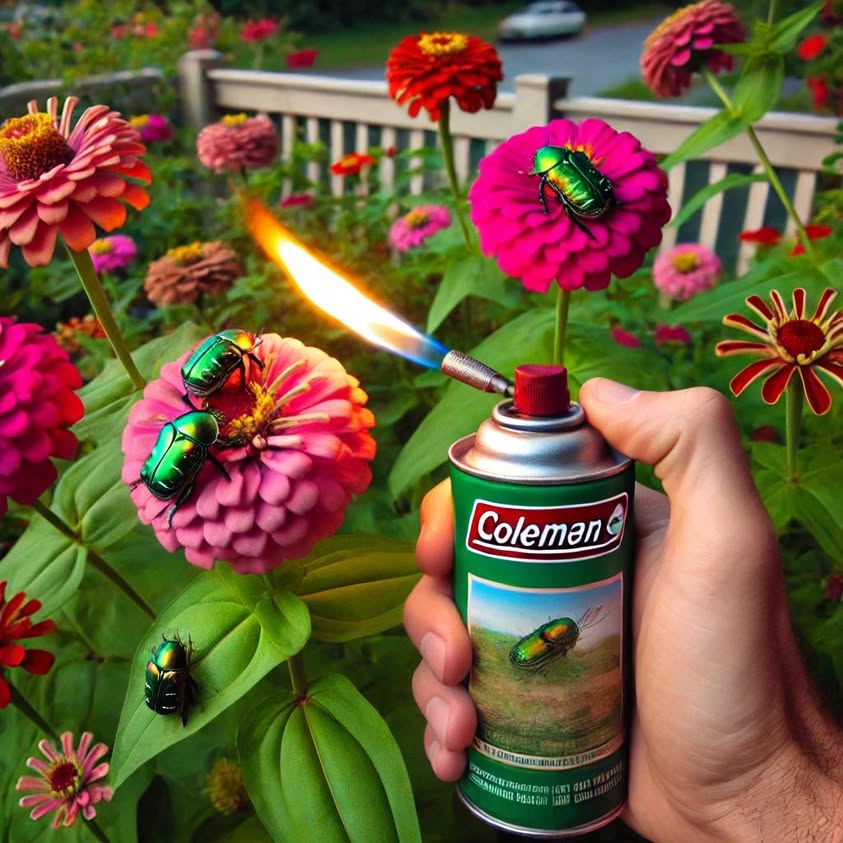
I was reflecting on last year’s garden and my having to resort to using a small propane torch to deal with a particularly nasty invasion of Japanese beetles. While I’m now considering more refined options—like beneficial nematodes for soil-dwelling grubs, neem cake or meal as a long-term deterrent, and diatomaceous earth to disrupt adult beetles—I can’t shake the feeling that I may still have to resort to the burn method if these other strategies don’t hold the line.
For those considering the burn method, let me offer a few hard-won lessons. It works—no question there. A short burst of flame delivers instant results, especially when the beetles are sluggish in the early morning. But it’s not without risk. One twitch of the wrist and a dry patch of mulch could go up. I kept a hose within arm’s reach at all times, and I never flamed near anything that could carry a spark. You have to be surgical, not theatrical. Just enough heat to crisp the beetle—not to roast your bean leaves.
Neighbours may raise eyebrows, and local fire bylaws don’t exactly smile on this kind of backyard justice. Still, when beetles gather in numbers and seem impervious to soaps and sprays, I can understand the impulse. It’s not the first line of defense, nor the second—but if you’re already losing crops and nothing else is working, it may be the last measure you reach for, torch in hand, with reluctant resolve.
When an army of Japanese beetles invades his garden, a desperate gardener resorts to extreme measures. But as the snap, crackle, and pop of scorched beetles fills the air, he’s left wondering—did he go too far to protect what was his?
It started with a few holes in the Zinnia leaves. Tiny bites. Nothing unusual. Probably a rogue caterpillar or a grasshopper passing through. I shrugged it off.
But within days, the holes grew larger. Leaves became skeletons, veins holding together what was left of once vibrant foliage. The blooms that had once stood proud and bright now wilted under the assault. I knew something wasn’t right.
Then I saw them.
Japanese beetles.
An army of iridescent green and copper bodies, shimmering like tiny jewels in the sunlight. But these jewels were harbingers of destruction. Every morning, I’d find them swarming the Zinnias, tearing through the leaves and petals with ravenous hunger.
At first, I tried handpicking them—one by one, plucking them off and dropping them into a bucket of soapy water. But for every beetle I eliminated, two more seemed to take its place. I escalated my efforts, smashing clusters of them between gloved hands, feeling the sickening crunch beneath my fingers.
It didn’t matter. They kept coming.
The Battle Escalates
They spread, as if mocking me.
After the Zinnias, they devoured the bean plants. Then the tomatoes. A few wandered over to nibble on the basil, as if sampling a buffet. I fought back, but it felt like trying to hold back a flood with a paper cup.
When they moved on to the Marigolds, I was stunned. I had planted them to repel pests—everything I’d read said Marigolds kept unwanted insects away. But a little more research uncovered an unpleasant truth: Japanese beetles love Marigolds.
They weren’t avoiding them. They were feasting on them.
By then, I was running out of options.
Desperate Times
One afternoon, as I surveyed the carnage in the garden, an idea struck me.
The propane burner.
It was tucked away in the shed, mostly used to clear weeds from between the patio stones. I hadn’t considered it before—too extreme, maybe. But I was desperate.
I pulled the burner out, checked the fuel, and gave it a test blast. A small, controlled flame hissed to life.
I hesitated. Was this really the answer?
But as I glanced at the Marigolds, their once bright petals shredded to ribbons, I knew I had no choice.
Snap, Crackle, Pop
The first beetle never knew what hit it.
A quick flick of the burner and—snap!—its tiny body erupted in a puff of ash and wings. The sound was oddly satisfying. Like a single Rice Krispie popping in milk.
I moved to the next cluster.
Snap.
Another beetle.
Crackle.
A group of them disintegrated in a brief flash of heat.
Pop.
The beetles fell, charred and lifeless, their iridescent shells reduced to blackened specks. The sound of their demise filled the air, a rhythmic crackling that echoed in the quiet of the garden.
Snap, crackle, pop.
I kept going. Methodical. Focused. One by one, I incinerated them, the hiss of the flame followed by that satisfying crackle. There was something primal about it—something darkly satisfying.
A Moment of Doubt
I turned off the burner, the sudden silence jarring. The garden was quiet now. No more beetles. No more destruction. But as I looked around, I felt… uneasy.
The blackened remains of beetles littered the soil like tiny casualties of war. The smell of scorched chitin hung in the air, acrid and cloying.
Had I enjoyed that too much?
The satisfaction I’d felt moments ago was fading, replaced by something heavier. Guilt, maybe. Or was it something darker?
Was I a sadist, taking pleasure in their destruction?
I swallowed hard, trying to shake the feeling. I wasn’t a monster. I was just… protecting my garden. Defending what was mine.
That’s all.
Victory… Or Something Else?
But the thought wouldn’t go away.
I glanced at the Marigolds, the beans, and the tomatoes. The leaves were no longer being devoured. The flowers stood a little taller. The garden was mine again.
Maybe it had been brutal. Maybe it had been harsh.
But it was necessary.
I walked back to the shed, stowing the burner away with care. I took a deep breath, trying to clear the lingering smell of scorched beetles from my mind.
I wasn’t a sadist.
I was just a gardener.
Right?
But as I left the garden, the faint echo of snap, crackle, pop lingered in my mind… and I wasn’t so sure.
Author’s Note
Japanese beetles can decimate a garden in a matter of days. While handpicking or using traps can sometimes control them, severe infestations often require more drastic measures. But every gardener has to ask themselves—how far are they willing to go to protect them.
If you enjoyed this story
From Japanese beetles to stubborn potatoes, there’s always another plan to rethink in the vegetable patch.
Leave a Reply