Originally posted on Facebook on March 15, 2025.
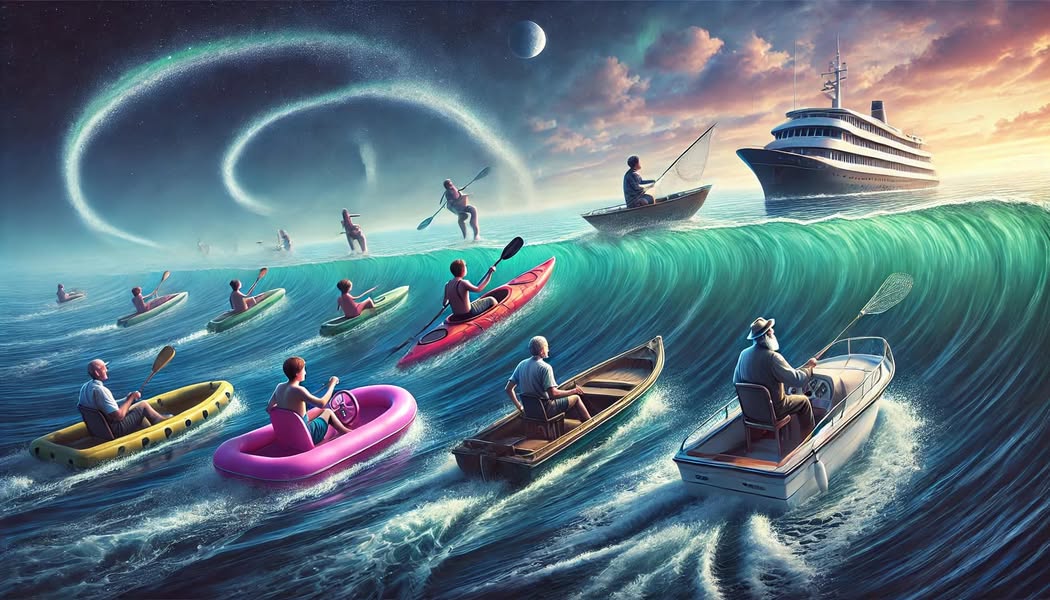
Dreams often reveal more than we realize. They mirror our subconscious, mapping out the emotions and transitions we struggle to define in waking life. In The Boats We Dream, a single character’s journey through the different stages of life is revealed by a series of boat dreams—each vessel reflecting a different stage of life, from childhood’s gentle drift to the relentless speed of midlife, and finally to the steady reflection of later years.
(Amended)
I. The Ring
I must have been four or five the first time I dreamed of water. I don’t remember the details of the day before, but I remember the dream as if it happened last night.
I was floating in a round, inflatable ring, the kind parents buy for children at the beach. The water was vast, stretching endlessly, but it wasn’t frightening. It was warm, calm, and blue like the sky. I bobbed gently, unable to steer, yet never feeling lost.
When I woke, I felt a strange sense of contentment, as if I had been carried somewhere safe. I never told anyone about it. To a child, dreams are just part of life, like afternoon naps and scraped knees.
II. The Pedalo
I was eight when I had the next boat dream. This time, I wasn’t floating aimlessly—I was in control. My little legs pumped the pedals of a peachy-pink pedalo, the kind you rent at parks. The water was still peaceful, but I could move now, decide where to go. I pedalled hard, making little ripples behind me.
I remember the feeling more than anything: the joy of making the boat move, the tiny power I had over the water. It wasn’t a race, nor was I escaping anything. I was just going—because I could.
Looking back, it was around this time I started insisting on tying my own shoelaces, pouring my own milk, choosing my own clothes. Maybe the dream had been a reflection of that new independence, my first taste of control over my small world.
III. The Rowboat
At thirteen, the water changed. It was darker, heavier, endless. I sat in an old wooden rowboat, clutching the oars. I rowed, but it felt futile. The water pulled at me, slowing my strokes. The sky was gray, and the air was silent, as if the world was holding its breath.
I woke feeling unsettled, restless. That year was difficult—my parents fought more, my body changed in ways I didn’t understand, and I felt caught between childhood and something else I wasn’t ready for. Maybe that was why the dream stayed with me, why I still remember the weight of those oars.
At the time, I didn’t think about it beyond the unease it left behind. But now, decades later, I wonder—was that the first time I truly felt adrift?
IV. The Kayak
By nineteen, the rowboat was gone. Now, I was in a kayak. The water was fast, thrilling. The world blurred past me in rushing currents, and I had to navigate quickly, adjusting course with every turn. I was no longer at the mercy of the water—I was part of it.
It was a dream that left me exhilarated. In my waking life, I was in university, experiencing freedom in a way I never had before. Late nights, new people, boundless energy. Life moved fast, and I didn’t want to slow down.
But dreams tell the truth we sometimes ignore. The kayak had no destination. I was moving for the sake of movement, dodging obstacles without knowing where I was heading.
V. The Sailboat
By my early thirties, the kayak had disappeared. One night, I found myself aboard a sailboat. The wind, not my hands, determined the pace. I had to read it, adjust to it, let it carry me rather than force my way through.
Unlike the kayak, I couldn’t just muscle my way forward. I had to wait for the right gust, trim the sails properly, anticipate changes before they came. It required skill, but also patience and trust.
In life, I was balancing responsibilities—a growing career, a family, decisions that had long-term consequences. I was no longer paddling through life recklessly. I was learning how to navigate it, learning the wind.
When I woke from that dream, I didn’t feel the same exhilaration as I had with the kayak. Instead, there was a quiet satisfaction, a sense of knowing that I was adjusting, responding, interacting—not just reacting.
VI. The Fishing Boat
The sailboat dream faded in my late thirties, replaced by something steadier. A small fishing boat, floating gently on the waves. I remember sitting in it, looking out at the horizon. I wasn’t in a rush. I cast a line into the water, waiting.
It was peaceful.
In my waking life, I had begun to settle down. A steady job, an ever-deepening relationship with my family, responsibilities. For the first time, I wasn’t chasing. I was waiting, learning patience.
And yet, there was always the feeling—what was I waiting for?
VII. The Speedboat
By forty, the fishing boat was gone. The water moved fast again, and so did I. A speedboat now, slicing through the waves, leaving a foamy trail behind.
Success had come. Promotions, a rambunctious family, a house, a life filled with movement. There was a renewed exhilaration, but also something else—a pressure to keep going, to never slow down.
I remember the sound of the engine in that dream. Loud.
VIII. The Cruise Ship
Now, I dream of something different. A cruise ship, vast and steady. I don’t steer it; I don’t need to. I walk its decks, looking out at the water, watching the waves roll endlessly.
It isn’t about control anymore. It isn’t about speed. It’s about taking in the view, reflecting on where I’ve been.
IX. Seeking Meaning
It wasn’t until much later that I started thinking about my dreams beyond mere memory. I have wondered why these dreams came in stages. Did I only notice them as I was ready to? Had they always been there, shaping my path while I slept?
Curious, I made an appointment with Dr. Reynolds, a sleep specialist with a background in dream research. He listened intently as I recounted the dreams, then nodded thoughtfully.
“Boat dreams are fascinating,” Dr. Reynolds responded. “Water represents emotions, and boats symbolize how we navigate them. What’s particularly interesting in your case is how the boats evolved.”
He explained Swiss psychoanalyst Karl Jung’s theory: recurring symbols in dreams aren’t random but part of a deeper subconscious narrative.
“Your dreams weren’t just visions—they were a mirror of your evolving self,” he said.
I asked if everyone had boat dreams.
Dr. Reynolds shook his head. “Not at all. But everyone dreams in patterns. Some people dream of traveling, shifting from bicycles to cars to planes. Others dream of houses, discovering new rooms as they grow. There are exam dreams, animal dreams, flight dreams—each tied to how a person processes their emotions and experiences.”
“So, my dreams aren’t unusual at all?”
“No,” he said. “But that doesn’t make them meaningless. Your dreams used boats to tell your life’s story. Others experience that same journey through different symbols. The key is recognizing the theme.”
I left his office with a list of books on dream symbolism, but more importantly, I left with a different perspective.
The dreams weren’t just random—they had been a map, a record of how I had moved through life, a map I didn’t always understand in the moment.
Maybe dreams aren’t meant to be understood immediately. Maybe they’re meant to guide us, slowly, over time, until we’re ready to see.
And maybe, I thought, I wasn’t done dreaming yet.
Author’s Note
This story was inspired by two things. First, an NPR radio piece I once heard about boat dreams and how they evolve throughout a person’s life, reflecting their subconscious journey. The idea that people dream of different boats at different life stages fascinated me, and I wanted to explore that concept through a single character’s experience.
The second inspiration comes from my own recurring dreams—not about boats, but about being lost in Montreal. In these dreams, I have no wallet, no money for bus or metro tickets, no cell phone to call for a ride, and a set of car keys but no memory of where I parked. With no clear way home, I wander through the city’s familiar yet disorienting streets, piecing together possible walking routes, improvising my journey as night settles in.
In a way, those dreams are also about navigation, about trying to find my way back to something secure. I wonder what Dr. Reynolds would have to say.
But that’s another story waiting to be told.
Leave a Reply