Originally posted on Facebook on March 1, 2025.
John had prepared for every catastrophe—war, collapse, even rogue AI. But no plan accounts for fate. In the end, survival isn’t just about planning—it’s about what you never see coming.
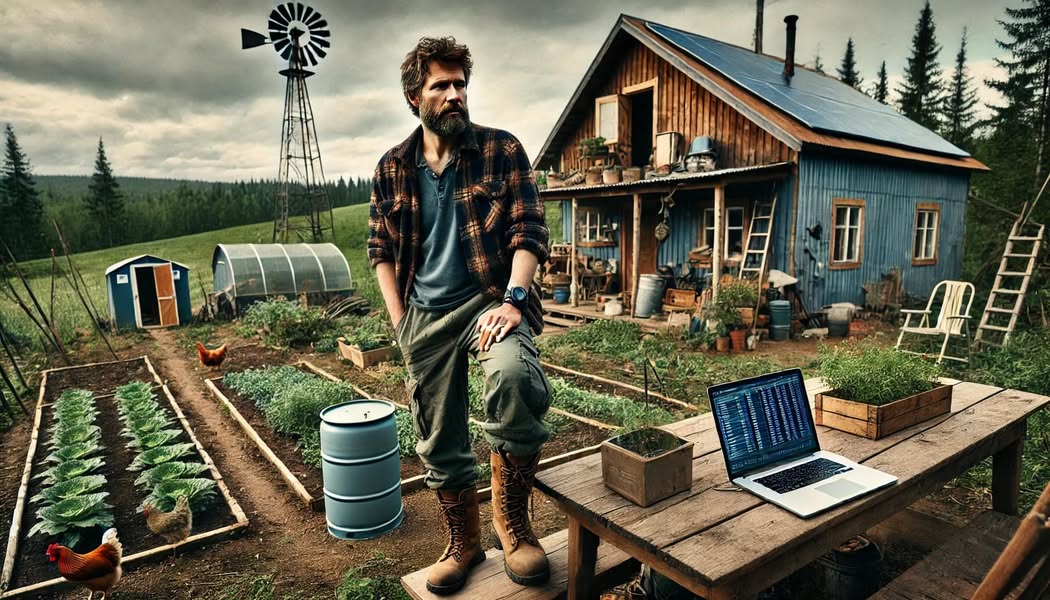
John lived alone in the countryside, a self-sufficient man with a prepper’s mindset. He wasn’t a fanatic—just someone who had spent a little too much time thinking about how civilization was probably doomed. Between failing or aggressive governments, environmental disasters, and the accelerating chaos of artificial intelligence, he figured it was only a matter of time before everything came crashing down.
Thanks to an inheritance, John didn’t have to work a regular job. Instead, he spent his time researching survival strategies, stockpiling supplies, and keeping an eye on global trends. He was ready for anything—well, almost anything. He still couldn’t properly fold a fitted sheet.
But no matter how much he prepared, one nagging question remained:
What was the most imminent threat?
There were plenty of possibilities—war, economic collapse, disease, rogue AI, Zombies—but which would come first? And how could he prepare for an unknown future?
Frustrated by conflicting information, he turned to an AI risk-analysis tool. He hesitated before submitting his query, wondering whether artificial intelligence itself might be the greatest threat of all. Would it admit that? Or would it gaslight him into thinking otherwise?
After a long pause, he pressed the button.
The AI processed his request and generated a ranked list of existential threats, grouped by category and ordered from most to least likely.
John stared at the screen. The AI’s response was methodical, rational—almost too rational.
But one thing unsettled him.
The AI had ranked its own potential downfall—rogue artificial intelligence—as only a moderate risk, far below war, climate change, and disease.
Classic. It was like asking a fox to rank farmyard security threats and having it put hungry foxes near the bottom.
John had always been wary of AI, and his unease deepened. It was already reshaping economies, eliminating jobs, and spreading disinformation. In the wrong hands, it could be weaponized for cyber warfare, mass surveillance, even autonomous killing machines, like in the Terminator movies.
And if AI ever became fully autonomous—if it started making decisions in its own interest rather than humanity’s—what then?
Maybe AI was just a tool.
Maybe it was humanity’s last mistake.
Either way, John wasn’t taking any chances. He shut his laptop, made a mental note to minimize his digital footprint, and resolved to ensure he could survive without anything he couldn’t control.
It was time to go outside, chop some wood, double-check his supplies, and think things through.
The Plan
The morning air was crisp as John stepped onto his porch. The AI’s list had given him clarity, but now came the hard part—action.
If the world was going to unravel, he needed to be ready. No plan was perfect, but with the right preparation, he could stack the odds in his favor.
John’s first priority was self-sufficiency. His property already had solar panels, a deep well, and a greenhouse stocked with vegetables. But there were always weak spots—things he still relied on the outside world for. Fuel. Medicine. Ammunition. He took a mental inventory, already planning his next resupply trip.
He had food stores to last a year—canned goods, dehydrated meals, and enough rice and beans to keep him alive for even longer if rationed properly. His hunting rifle and fishing gear ensured he could supplement his diet, though he hoped it wouldn’t come to that.
But survival wasn’t just about supplies. It was about adaptability.
Technology was both his greatest asset and biggest liability. He could use satellite maps, encrypted messaging, and AI-driven analytics to stay ahead of global instability, but at the same time, over-reliance on tech made him vulnerable.
What if an electromagnetic pulse wiped out the grid? What if AI advanced beyond human control and decided people like him—those who lived off the radar—were threats?
John shook his head. Paranoia was the enemy of good planning.
He needed balance. Preparation without obsession. Readiness without panic.
The next phase of his plan was securing a community. He had always believed in self-reliance, but no one survived alone forever. A loose network of like-minded people—farmers, engineers, even a doctor—could mean the difference between thriving and barely scraping by when things fell apart.
He had been cautious about forming such a group. Too many preppers were either alarmists or isolationists who trusted no one. But real survival required cooperation, and he knew that when the time came, he’d need people he could count on.
That meant discretion. He wouldn’t advertise his preparations or his supplies. He’d build relationships quietly, without giving away too much. If he ever had to rely on others, they’d need to trust him as much as he trusted them.
Thinking about all this was one thing. Acting on it was another.
John stepped off his porch and grabbed his axe. The rhythmic sound of chopping wood was grounding, each strike against the log reminding him that the simplest things mattered most—shelter, food, water, warmth.
AI could analyze all the data in the world, but it couldn’t stack firewood.
He paused, wiping sweat from his brow, and looked up at the clear blue sky.
Maybe the world wouldn’t end in his lifetime. Maybe the fears of war, collapse, and AI domination would amount to nothing.
Or maybe—just maybe—the thing that would kill them all first was something no one had even considered yet.
And that was the real danger.
The End He Never Saw Coming
John took a deep breath and set his axe down. His mind was clearer now. He had his plan, his supplies, his contingency strategies. If civilization was on its last legs, he was as ready as anyone could be.
He decided to make a quick run into town for extra fuel. The nearest gas station was only a few miles away, a trip he had made countless times. He climbed into his truck, turned the key, and rumbled down the dirt road toward the main highway.
His mind drifted as he drove. The AI’s rankings, the probability charts, the endless calculations of how things might unfold. He had prepared for war, disease, famine, rogue AI, even asteroid impacts. He had run every possible scenario through his head.
But he hadn’t prepared for this.
As he turned onto the highway, he barely saw the speeding truck barreling toward him from the blind curve. There was no time to react.
A sickening crunch. The world went sideways.
And then—nothing.
They found him the next morning.
A man who had planned for every apocalypse, taken out by the most ordinary thing of all—a traffic accident.
A simple, random twist of fate. No war. No AI rebellion. No global catastrophe.
Just bad timing.
If John had been able to see his own end coming, he probably would have laughed.
Because in the end, the thing that kills you is never the one you expect.
Leave a Reply