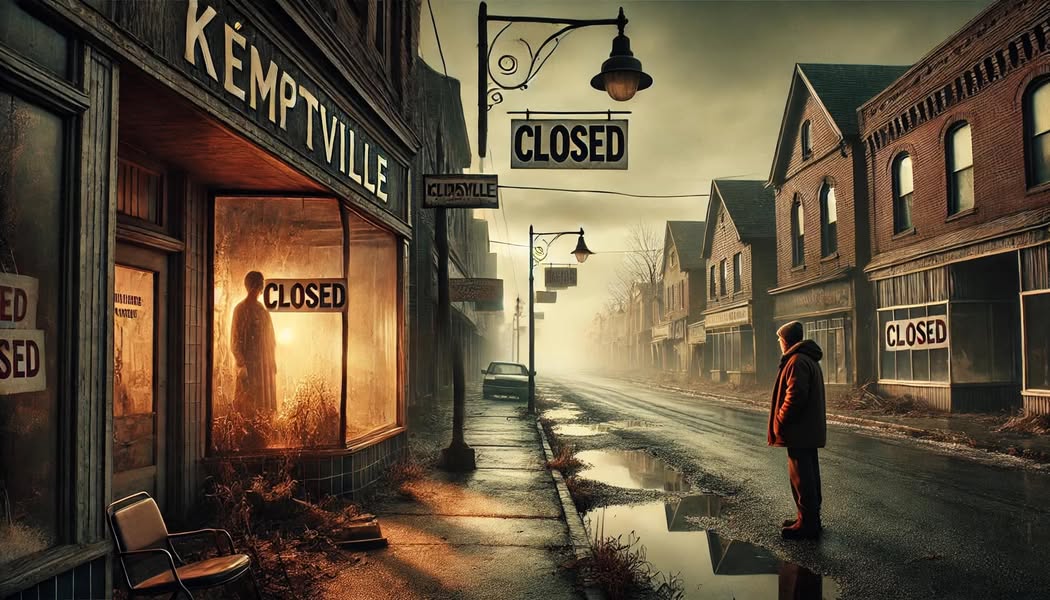
A not impossible dystopian tale. In the quiet town of Kemptville, the echoes of a global trade war reverberate through empty streets and shuttered stores. When tariffs ignite economic collapse, Hélène and Emile watch their once vibrant community unravel, neighbors vanish, riots erupt, and survival hinges on dwindling resources. As silence engulfs their world, the couple clings to fragile hope, confronting a haunting question: can the life they cherish endure, or will the fallout claim even their resolve?
Story
Hélène sat by the window in their small living room watching as the last rays of light faded over Kemptville’s empty streets. The house felt quieter lately, emptier. Even the birds seemed to have disappeared. A few weeks earlier she would have caught sight of neighbours walking to the corner store or kids riding their bikes, but now the streets were bare. It wasn’t just the cooler weather, it was something else, something she couldn’t quite put her finger on.
“Any word from the girls?” Emile called from the kitchen, slowly working through the pile of overdue bills. He had retired years ago from the local newspaper, and the rhythms of his life had been simple, until the calls started coming. Local business owners, desperate for any lifeline, had reached out to him, hoping he knew someone, anyone, who could help.
Hélène shook her head. “Nothing today. I think Chantal’s too busy, but I’m sure Marie will check in soon.” Their daughters, one near Montreal, the other in Ottawa, had tried to stay optimistic, but they all knew the reality. The news was the same everywhere: factories shutting down, trucks not moving, the economy crumbling.
Kemptville had always felt like a cozy place, nestled between Ottawa’s chaos and the countryside’s quiet. But now, even that was fading.
Global Trade War & Economic Collapse (Weeks 1-3)
The first signs of trouble weren’t subtle. The regional newspaper had reported the 25% tariffs and Trump’s threats of annexation, but at first, it seemed distant—political theatre more than anything real. Then the job cuts started. The auto plants in Ontario made their first round of layoffs. Then another. Then another.
Hélène and Emile felt the shift in small ways at first. Everything cost more, store shelves weren’t as full. Then, almost overnight, grocery prices jumped 15%. Whispers of food shortages became real when people started hoarding. It was the Covid toilet paper scenario all over again, only worse.
The local radio station, already struggling, stopped broadcasting. The newspaper stopped printing. The hardware store laid off its last employees. The gas stations ran out of fuel.
Neighbours slipped away quietly. Some left for bigger cities, hoping for work. Some simply packed up and vanished, unable to afford one more month of bills.
Initially there had been quiet hope that things would stabilize. But each day, something else disappeared. Handwritten “Closed Until Further Notice” signs went up. The town’s pulse slowed.
Mass Business Closures & Urban Decay (Months 1-3)
By the end of summer, Kemptville was a ghost town. The once-busy main street, lined with local shops and the occasional chain store, stood hollow. The CLOSED signs never came down.
Of the larger stores, Walmart closed first — not just from declining sales and stock; Anti-American sentiment had made it a target of resentment. Independent followed soon after, its high prices unsustainable in an economy where every dollar mattered. Food Basics and Giant Tiger fought hard to adapt but eventually succumbed.
The bakery shut its doors. The remaining Tim Hortons, once a gathering place for retirees and morning commuters, held on, but barely.
With fewer folks gathering, the casual exchanges that had once been part of daily life—baking tips, garden advice, political gossip—began to fade. Silence took their place.
Hélène missed the chatter. She missed feeling like she belonged to something. Now, the silence felt heavy. Oppressive.
Civil Unrest & Fear-Driven Lockdowns (Months 3-6)
It was only a matter of time before anger spilled over.
Ottawa, just a half-hour drive away, saw the first riots. Crowds barricaded the American Embassy, throwing stones and bottles, setting fires. Factory workers and other unemployed gathered outside federal and provincial offices, demanding action. The tension spread, a slow-moving fire reaching toward Kemptville.
One cold afternoon, Emile went to B&H, the only grocery store still open, and saw a clot of people marching down the street. Young and old, their faces tight with frustration. They muttered about both levels of governments’ inaction, the rising costs, the sense of being abandoned. That night, a curfew was announced. The streets of Kemptville were empty by 7 p.m.
Hélène sat in the living room, watching the news. The screen showed riot police clashing with protestors in downtown Ottawa and other major cities across Canada. Her hands trembled.
“The violence won’t stay in the cities, Emile,” she whispered. “The protestors and the police… they’ll be here soon. I am afraid.”
Emile didn’t answer. He didn’t know how to reassure her. He had seen too much, heard too much.
Mass Migration & Ghost Towns (Months 6-12)
Winter arrived swiftly, bringing with it the departure of those who could still afford to leave. Hélène and Emile had always cherished the quiet rhythms of small-town life, but now the silence was unnatural. Their neighbours, their community- had vanished.
Some had moved to Ottawa, chasing non-existent jobs. Some took their chances in Quebec. Despite the province’s escalating push for independence, some saw it as their best hope. The Quebec government, eager to prove it could stand on its own, expanded social programs and economic aid, drawing desperate Ontarians across the border. But uncertainty loomed. If Quebec left Canada, what then?
Infrastructure & Supply Chain Collapse (Year 1-2)
By the time the first snow fell, Kemptville was a shell of itself. The last grocery store had closed. The gas stations had long since run dry.
Emile’s blood pressure was rising dangerously, but the only pharmacy still open, Seaway, was two towns over in Winchester. Hélène, once full of energy, spent her days in quiet reflection, wondering if the life they had built had all been for nothing.
Digital & Remote Work Acceleration (Year 2+)
By the second winter, Hélène and Emile were the last residents on their street. They had survived so far due to their well water, electricity provided by solar panels, a productive vegetable garden, a larder once well stocked with canned and preserved foods and Emile’s pride and joy, an old pickup truck converted with a gasifier to burn wood as fuel.
Their daughters tried to keep in touch, but their calls became fewer and farther between. Their satellite internet had become their only window to the world. The young had retreated online.
Hélène reached for Emile’s hand, her fingers curling around his as they had on their wedding day, as they had through every hard winter before this one.
“Do you think we’ll ever see them again?” she asked, her voice smaller than she wanted it to be.
Emile squeezed her hand gently. “I hope so, Hélène. Wé’ll keep going until we do.”
The Final Collapse
By the third year, nothing was left to hold the country together.
What had started as a tit-for-tat tariff war had metastasized into something far worse. The first sanctions had been economic, a calculated show of force. Then came the reprisals, escalating with each retaliatory blow. Trade collapsed, alliances fractured, and desperation set in. Nations, stripped of stability, turned inward—hoarding, rationing, arming. The last embers of diplomacy and democracy died in closed war rooms, and everywhere, the engines of industry gave way to the engines of war.
Hélène and Emile still watched streamed news—what little was left of it. The broadcasts had grown shorter, darker.
One evening, as Emile turned off the screen, his voice was barely above a whisper. “It was always going to end like this, wasn’t it?”
Hélène didn’t answer.
In the distance, the sky lit up and the cold wind carried the rumble of something more than thunder.
(Special thanks to Hendrik de Pagter for his editorial input.)
Leave a Reply