Originally posted on Facebook on January 24, 2025.
Have you ever noticed a lone tree in a field and wondered why it stands there? I am one of them, a sentinel, spared to witness and shelter. This is my story.
Have you ever driven along a country road and wondered about that single old tree, or perhaps a small group of old trees, standing steadfast in the midst of a farm field? Were they forgotten, or were they spared?
Let me tell you that we were spared.
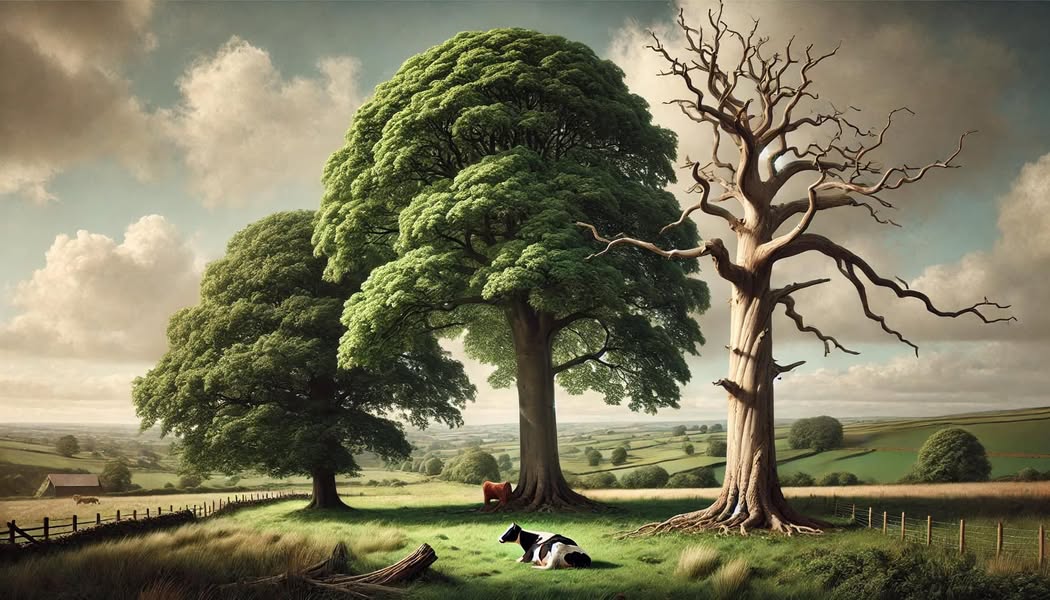
I am a sugar maple, my crown reaching high into the sky, my roots delving deep into the soil. For well over a century, I have stood here, partnered by the sturdy oak to my left and the graceful poplar to my right. Together, we are the sentinel trees of this field.
Our story began with a farmer named Samuel, whose family first cleared this land. He was a practical man but also sentimental. Samuel spared us because his father, a man who knew the land well, had once rested under my shade after a long day of planting. "Let them stand," Samuel had said to his sons. "The livestock will need a place to rest. And when the sun is blazing, we will rest as well."
In those days, cows grazed beneath us, swishing their tails lazily while the children of the farm played games in our shadow. The soil was tilled by hand, and the rhythm of life was slower, more attuned to the heartbeat of the land. My companions and I stood watch, guardians of the field and its creatures.
The Changing Times
But times changed, as they always do. The livestock gave way to machines, and the children grew up and moved away.
The field around us filled with corn, soybeans or cereal grains, planted by roaring tractors and harvested by towering combines. Samuel’s descendants debated our fate, but they ultimately let us be—partly out of respect for tradition and partly because my roots, spreading wide and shallow, made tilling too close to me impossible without risking damage to the equipment.
The oak and I adapted, our roots digging deeper, our branches spreading wider, but the poplar began to falter. The emerald ash borer arrived two decades ago, burrowing beneath its bark and draining its vitality. Now, its branches are bare more often than not, its once-smooth trunk marred with scars. I can feel its struggle through the intertwining of our roots. Through the mycorhizzal network, the language of trees often called the wood wide web, we whisper encouragement to it, but I fear it will not last another year.
Our Role
Even now, as the world rushes past, we sentinel trees remain more than just relics of another time. We are shelter and sustenance. Hawks perch on our branches, scanning the field for prey. Squirrels chatter as they scurry along our limbs, and insects hum in the crevices of our bark. On quiet mornings, I watch deer graze near the edge of the field, taking solace in our presence. Even in our isolation, we are a haven.
Farmers, too, still find value in us. Though the fields around us are tilled and planted with precision, we offer a measure of balance. Our shade cools the soil, and our roots stabilize the ground. Samuel’s great-grandson practices no-till farming here, mindful of how our roots extend into the earth. He understands that preserving us benefits not just his yields but the land itself.
Though I have stood in this field for over a century, I am not entirely isolated. Trees have a way of sharing stories, carried on the wind or whispered through the earth. I have learned of other sentinel trees on neighboring farms, each with its own history and purpose.
The towering elm that once shaded a barnyard two fields over. The lone cedar guarding a spring-fed pond. The ancient oak that stands watch near a stone wall. The two remaining sugar maples, one of which is hundreds of years older than I and five feet across. They stand by the house that Bill Hamilton carefully positioned to protect them when he built it in the ‘80s.
All have their tales to tell. Through the years, these stories have reached me; stories of farm families that have come and gone, reminders that I am part of a greater tapestry of life tied to the land and its people.
Reflections on Loss
As the seasons pass, I cannot help but feel the loss of others like us. Many sentinel trees have been felled for the sake of efficiency or succumbed to disease—like the oak on the Mellons’ farm.
The Mellons had farmed that land since the 1830s. Cows once grazed there after the first hay cut, but as time went on, the field was tilled for crops, with the old oak standing watch—until 1972, when Ward and Lyle Mellon worried the dying tree might fall.
Had it been consulted, the oak, which stood just a mile or so from me, would have disagreed, but that winter, the decision was made and the brothers rode up to it, Lyle on his nearly new Ski Whiz 400 snow machine.
Ward did the cutting and later blamed a rogue gust for the oak’s sudden twist, but the winds and the earth whispered to me the tree’s final thoughts as it flattened the snow machine. "Someone will write a story about this moment."
The horizon grows emptier each year. And now, as I glance at the poplar, I feel the weight of its impending absence. Its bark peels away in sheets, and its branches groan even in the lightest winds. It was once the tallest of us, its silver leaves shimmering in the sunlight, but now it leans, tired and brittle.
The oak and I will remain, but without the poplar, our trio will feel incomplete. Still, I take solace in the knowledge that its decay will nourish the soil and perhaps give rise to new life.
Hope for the Future
Not all is despair. In recent years, I have seen young trees planted along the edges of fields and near streams.
Conservationists have begun to understand what Samuel knew instinctively; trees like us are not obstacles but partners in the stewardship of the land. We lend our strength to the earth, our shade to its creatures, and our beauty to those who pass by.
A Final Reflection
If you find yourself driving down a country road and your eyes catch a lone tree or a small cluster standing in a field, remember that we are not forgotten. We are survivors, sentinels of time, witnesses to the changing dance of nature and humanity. And if you stop, step into the field, and rest against my trunk, you might well hear the whispers of the past in the rustling of my leaves.
Fun facts; not strictly Sentinel Trees, but symbolically so.
-Hyperion, a Coastal Redwood in California is estimated to be between 600-800 years old but perhaps more importantly believed to be the tallest tree in the world at 380 feet. -Adonis: a Heldreich’s Pine in Greece is the oldest known tree in Europe, estimated to be 1230 years old.
-Methuselah, a Great Basin Bristlecone Pine in California is estimated to be over 4850 years old.
-Gran Abuelo, an Alerce in the Chilean Patagonia is estimated ro be over 5400 years old.
-Pando Quaking Aspen Grove, a single root clonai colony of quacking Aspen in Utah is estimated ro be between 80,000 and 100,000 years old.
-The oldest known living tree in Canada is a Whitebark Pine located in the Rocky Mountains of British Columbia and is estimated to be over 1300+ years old.
-Ontario’s oldest known tree is an Eastern White Cedar situated on the the Niagara Escarpment and is estimated to be 1330 years old.


Leave a Reply