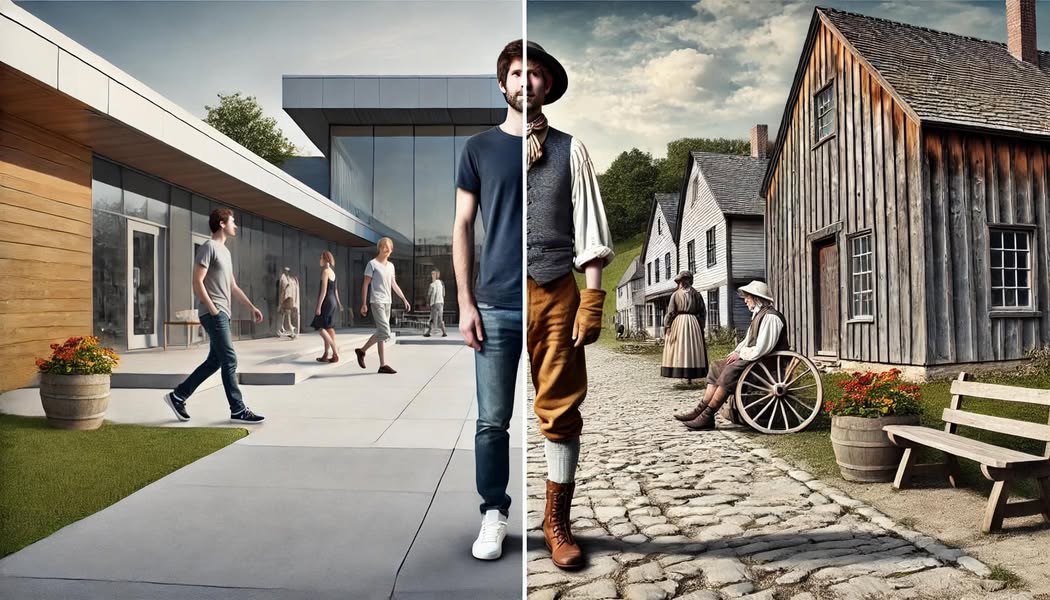
Originally posted on Facebook on December 27, 2024.
What if your mind could take you to a time long past? For Ethan Laramie, the past isn’t just history—it’s a living, breathing reality. As he battles schizophrenia, Ethan must learn to navigate both worlds, finding peace between the ghosts of history and his present life. Fractured Realities is a powerful journey of self-acceptance and belonging.
Ethan Laramie had always stood apart. In the close-knit community of Morrisburg, Ontario, where hockey games and backyard barbecues were staples of life, Ethan preferred solitary pursuits. While his peers filled their weekends with gaming marathons, talking about girls or loitering at the Cornwall mall, Ethan was lost in history books and late-night internet searches, uncovering the trials and triumphs of Canada’s early settlers. He felt drawn to their simple, rugged lives—wooden cabins warmed by crackling hearths, fields of freshly turned soil, and tools that bore the weight of survival.
This fascination deepened during a family trip to Calgary’s Heritage Park Historical Village when he was sixteen.
Ethan had wandered the park’s wooden pathways as though stepping back in time. Horse-drawn carriages clattered past, their wheels carving lines in the dirt. The general store buzzed with reenactors, their voices thick with an authenticity that filled him with wonder. Yet Ethan felt more than curiosity; he felt a connection so visceral it left him silent, heavy with a longing he couldn’t explain. His parents dismissed it as a teenage phase, but for Ethan, the past wasn’t just history—it was home.
As Ethan matured, his passion for history evolved into something less benign. By the time he turned twenty-one, his habits had become peculiar. He slipped antique phrases like "mark me words, so." into casual conversation and swapped jeans for homespun shirts and sturdy leather boots. His parents, baffled but supportive, chalked it up to eccentricity.
But then the episodes began.
During a summer visit to Upper Canada Village, Ethan’s sanctuary among Ontario’s heritage sites, his perception fractured. The asphalt paths and modern conveniences faded, replaced by the clink of iron tools and the smell of hay.
He heard voices: a man saying “ We’ve tae get the wheat in afore the rain comes doon” followed by a woman’s fretful reply “Ach, ye ken we cannae be lang aboot it, or the storm’ll lay waste tae the hale crop!” When Ethan blinked back to reality, he was gripping a wooden pitchfork in the village’s replica barn, surrounded by a startled tour group.
Ethan’s parents urged him to seek help. After months of evaluations, he was diagnosed with mild schizophrenia. The news struck like a thunderclap, forcing Ethan to confront unsettling questions. Were his vivid episodes a product of illness, or did they hold deeper meaning? His initial resistance to treatment stemmed from fear: antipsychotic medications dulled the episodes, muting the very world he cherished.
Therapy, however, opened a different door. Ethan worked closely with a counselor, exploring grounding techniques to tether himself to the present when his mind wavered. He began to understand his condition as both a challenge and an explanation. With time, he collaborated with his psychiatrist to adjust his medication, finding a balance that lessened his symptoms without severing his connection to history.
One crisp autumn afternoon, as Ethan sat along the banks of the St. Lawrence River near Upper Canada Village, he found clarity. The water mirrored fiery leaves overhead, and for the first time in months, he felt a fragile peace. He realized he didn’t need to forsake one reality for the other. Perhaps, he thought, his love of the past and his diagnosis could coexist.
Ethan applied for a job at Upper Canada Village. Immersing himself as a historical interpreter, he wore period clothing and led visitors through the village with an authenticity few could match. His encyclopedic knowledge and genuine passion for settler life made him a favorite among staff and tourists alike.
The work was not without its struggles. Ethan learned to navigate his condition with the same determination settlers had once brought to their fields. His episodes, while unnerving, became less daunting as he developed strategies to manage them. The community at Upper Canada Village became a wellspring of support, fostering an environment where Ethan’s unique perspective was celebrated, not judged.
Through continued therapy and carefully adjusted medication, Ethan maintained stability. He no longer viewed his diagnosis as a barrier but as a bridge—a link between his love of history and his lived reality. For Ethan, schizophrenia was not an anchor but a guide, drawing him into a realm where the past and present coalesced in unexpected harmony.
In the timeless streets of Upper Canada Village, Ethan found more than a job—he found belonging. Here, in a place that straddled eras, he could live in both worlds without apology, channeling his experiences into a story as unique and enduring as the settler dreams that had first inspired him.
(This story was inspired by my recollections of the difficulties as a union representative trying to have the employer recognize the Duty to Accommodate a schizophrenic who often failed ro take prescribed medication, consequently exhibiting bizarre behaviour. Schizophrenia is recognized as a disability and employers must accommodate an employee to the point of undue hardship, considering factors like financial cost and workplace safety. There are around 150,000 people diagnosed as suffering from schizophrenia in Ontario.)
Leave a Reply