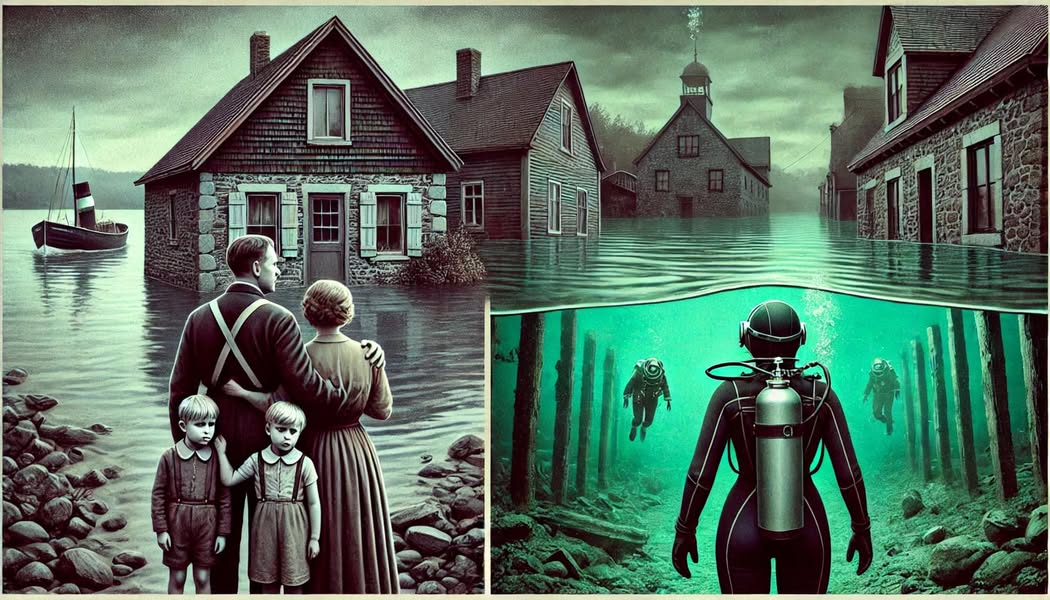
Past: 1950s
Along the Saint Lawrence River, the small village of Iroquois was a close-knit community defined in part by its French Canadian roots and its reliance on the river. Families like the Lefebvres, Dufresnes, and Lemoines had lived there for generations, each contributing to the vibrant life of the village. The Saint Lawrence shaped their daily routines, from fishing and farming to shipbuilding and teaching.
Louis Lefebvre, a skilled shipbuilder, had spent his life crafting vessels that would sail the very waters threatening to erase his home. His daughter, Madeleine, a schoolteacher, loved the rhythm of life in Iroquois. Every morning, she walked the cobbled streets, greeting neighbors and watching children play along the riverbank. The village was more than a place to live—it was an extension of its people, a testament to their perseverance and unity.
The tranquility began to unravel in the early 1950s with the announcement of the Saint Lawrence Seaway project. The Canadian and U.S. governments planned to create a navigable waterway for ocean-going ships, an engineering marvel that promised economic growth but required devastating sacrifices. Entire villages, including Iroquois, Morrisburg, and Aultsville, would be submerged.
Louis and Jeanne Lefebvre were among the first to understand the magnitude of the change. For Louis, it was the loss of more than a home—it was the erasure of history, a legacy tied to the land and water. “It feels like tearing pages from a book,” he told Jeanne one evening, watching the sun dip below the horizon. Jeanne, ever pragmatic, held his hand and said, “We will write new ones.”
The government promised modern housing in a newly constructed Iroquois, but many residents felt displaced in more than just a physical sense. The new village lacked the character of the old, its orderly rows of houses feeling sterile compared to the organic charm of cobbled streets and weathered stone.
The Dufresne Family
The Dufresnes lived just a few streets away from the Lefebvres. Jean, a farmer, tended fields of corn and potatoes that his family had cultivated for over a century. His wife, Simone, was known for her homemade bread, baked with wheat grown on their own land. Their children—Lucie, André, and René—helped with chores, their laughter filling the air as they played in the fields.
When Jean brought home news of the flood, Simone froze, her hands dusted with flour. “What will we do with the farm?” she whispered. Jean had no answers. The government offered compensation, but no amount of money could replace the soil that had nourished their family for generations.
André, the eldest son, struggled the most. On the last evening before their move, he stood at the riverbank, the water lapping at his boots. “How can they take this from us?” he asked, his voice shaking. Jean placed a hand on his shoulder. “They can’t take the memories, son. And they can’t take who we are.”
The family relocated to a new plot of land, but the soil was unfamiliar, the horizon empty of the river’s gleaming expanse. Simone’s bread never tasted the same, and André stopped walking to the river’s edge.
The Lemoine Family
Gérald Lemoine, a fisherman, had always lived by the rhythm of the river. His wife, Claire, wove baskets from river reeds, selling them to supplement their income. Their children—Michel, Cécile, and Pierre—grew up with the smell of fish and the sound of water in their ears.
For Gérald, the Seaway project was incomprehensible. The river that had provided everything now threatened to take it all away. Claire, ever the optimist, tried to hold the family together. “We’ll find a new way,” she said, though her voice wavered. But when the water rose and their cottage became unreachable, her composure cracked.
The Lemoine family moved to an inland town, their baskets gathering dust in storage. Gérald took up factory work, his hands aching for the feel of a fishing net. Claire, who once hummed as she wove, grew quiet.
Present: 2020s
Decades later, the original village of Iroquois lies beneath the Seaway’s waters. The new town, though thriving, carries the shadow of its predecessor. The memories of the Lefebvres, Dufresnes, and Lemoines remain vivid in the stories passed down through generations.
Clara Lefebvre, Madeleine’s granddaughter, returned to Iroquois to explore her family’s past. A diver by profession, she was drawn to the submerged remnants of the lost villages. On a crisp autumn day, she joined a team of archaeologists to explore the depths of the Saint Lawrence.
As Clara descended, the water grew darker, and shapes began to emerge. Stone foundations, rusted metal, and fragments of everyday life—cups, pots, and broken furniture—came into view. Then, she spotted something extraordinary: a wooden beam etched with the name Lefebvre. Her heart raced. This wasn’t just history; it was her family’s history.
When she resurfaced, holding a photograph of the carving, Clara felt a profound connection. “It’s still here,” she whispered. “We’re still here.”
The legacy of Iroquois lives on—not just in the memories of those who were displaced, but in the spirit of resilience that defines their descendants. Beneath the surface of the Saint Lawrence, the lost village continues to whisper its story, reminding all who listen of the strength it takes to begin anew.
(This story is a work of fiction inspired by the lives of countless families affected by the Saint Lawrence Seaway project. While the characters and events depicted here are fictional, they are drawn from a collective understanding of the challenges and sacrifices faced during a time of great change. Care has been taken to avoid specific names or circumstances to ensure that the narrative honors the broader human experience without inadvertently reflecting the personal histories of any particular family. This story is meant as a tribute to resilience, adaptation, and the enduring connections to the places we call home.
For those readers who previously had no knowledge of this part of Canadian history, you may wish to visit the CPAC. CA website and search under the title “the lost villages of the Saint Lawrence Seaway” for a fascinating, albeit a bit long video.)
Leave a Reply