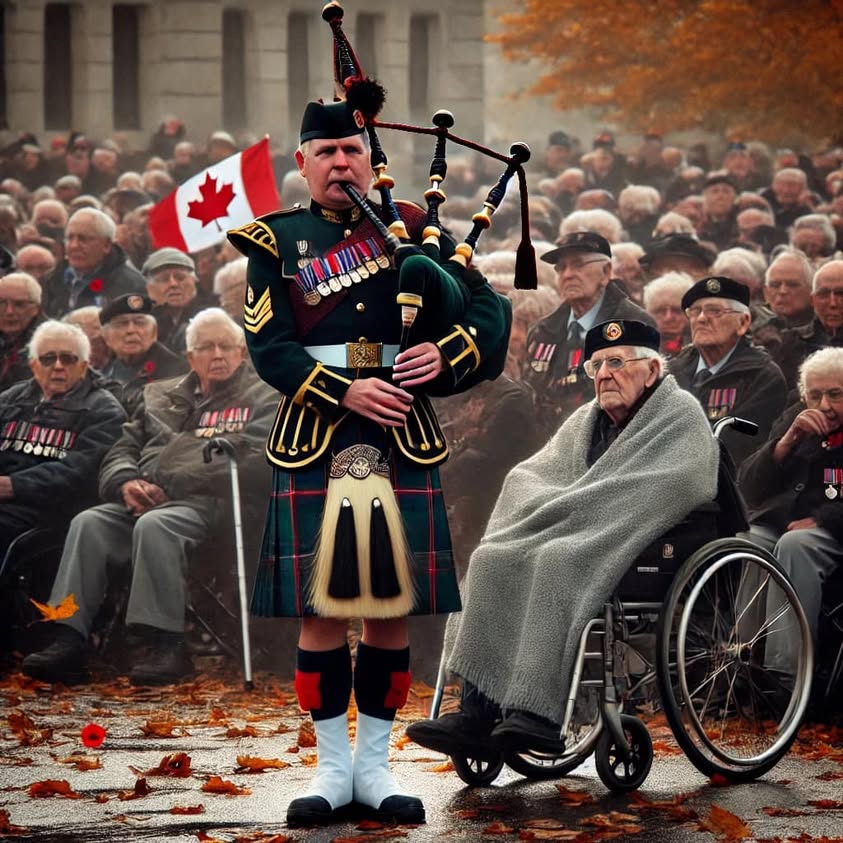
This story is dedicated to the memory of my father-in-law, Gaston Belanger, and his brothers, whose service in Holland during the Second World War contributed to the liberation of Holland and the survival of my parents, grandparents, and their families.
I remember that chilly morning in 2004, the cold air biting through our coats as we made our way from South Mountain toward the National War Memorial in downtown Ottawa.
After parking some distance away, too far to walk, the four of us sat in a taxi: my father-in-law beside the driver, our wives and I in the back.
My father-in-law sat a little straighter than usual, his gaze focused ahead, lost in memory. He was a veteran of the Second World War, and though age had slowed him down, his pride was as strong as ever.
He and my mother-in-law lived in Rouyn-Noranda, Québec, far from the bustling capital. He had attended all the Remembrance Day ceremonies at the local WWII Memorial Obelisk, but just once, he wanted to make the long journey to stand at this memorial, among those who knew the weight of service. It meant the world to him.
When the taxi pulled up near the memorial, I reached for my wallet, but the driver waved it away. “No need,” he said, speaking to my father-in-law. “I see your medals, sir. There’s no charge for a veteran like you.” My father-in-law gave a quiet nod of thanks. He wasn’t one for grand displays, but I could tell the gesture touched him deeply.
We stepped out and walked toward the memorial, my wife hanging back with her camera in hand, ready to capture the day’s moments. She had always been the one behind the lens, preserving memories I might later forget.
We found a spot near the front. I helped my father-in-law settle in, his medals gleaming in the soft light, while my mother-in-law stood beside him, gently holding his arm.
The crowd thickened as the start time of the ceremony drew near. My wife took photos of him standing proudly before the towering stone monument and then of the two of us together—he in his waist-length parka and military beret, me in my black leather coat and ushanka—a fur hat he had gifted me years earlier. I wasn’t usually one for photos, but this felt different. There was something about this moment that I knew I wanted to remember.
I had chosen to wear my Queen Elizabeth Golden Jubilee medal. Remembrance Day was the only day I was permitted to wear it publicly, though it always left me feeling slightly guilty when I reflected on the difference in how our respective service medals had been earned.
All around us, veterans gathered, male and female. Some were frail, in wheelchairs or leaning on walkers, but their medals shone with the same pride. Their faces held stories of battles fought, friendships lost, and experiences that had shaped them in ways both seen and unseen. For some, the scars of war lived on in what had once been called battle fatigue, now known as PTSD—a quiet struggle they carried with them, even as they stood strong.
It struck me how time had worn down their bodies, but not their spirit, or the deep strength they carried within.
Before the speeches began, one of the organizers spotted my father-in-law and invited him to move out of the crowd and stand on the pavilion with the rest of the veterans.
The crowd fell silent. Words of service and sacrifice filled the air, but it was the veterans themselves who spoke the loudest. Their presence, their quiet dignity, carried more weight than any speech. I glanced at my father-in-law, standing tall despite the years, and felt a surge of pride.
Then, the roar of engines cut through the stillness. A formation of planes appeared in the sky, a tribute to the men and women below. The Air Force flyover was perfectly timed, a salute to the veterans. We all looked up as the planes passed overhead, my father-in-law’s eyes following them. For a brief moment, I saw in him the young man he had once been—full of fire and duty—as the planes carried his memories into the clouds.
As a trumpeter played “The Last Post” and a bagpiper played “Going Home,” I knew he was thinking of his brothers, one of whom had made the ultimate sacrifice in Holland, the other who had been irreparably damaged by the war. The memory, though painful, was part of what made this day so significant for him.
After the ceremony ended, we joined other veterans and their wives for a complimentary brunch at the nearby Queen Elizabeth Hotel. It was a gesture of thanks, and it felt like the right way to close the day.
The brunch was simple but warm, with rows of tables filled with veterans, their families, and officials. Laughter and conversation mixed with moments of reflection. My father-in-law, a member of the Royal Canadian Legion back home and always sociable, found himself deep in conversation with other veterans, exchanging stories only they could truly understand.
As I looked around the room, I saw faces that had lived through so much, carrying the weight of war and the passing of time. The day had been one of remembrance, yes, but also one of community, of shared history. And though I knew the years were catching up to my father-in-law, I felt grateful for this moment, for the time we had all shared.
As we prepared to leave, I caught my wife’s eye. She had captured the day on her camera, but I knew it was the memory itself—of us all together—that would stay with me the longest. We had come to honor the past, but in doing so, we had created something new—a day that would live on in our hearts, long after the planes had disappeared from the sky.
(Three of Gaston’s sons and one of his grandsons subsequently served in the Canadian Armed Forces, one of whom survived intense shelling while serving as a Blue Beret in the Golan Heights.)

Leave a Reply