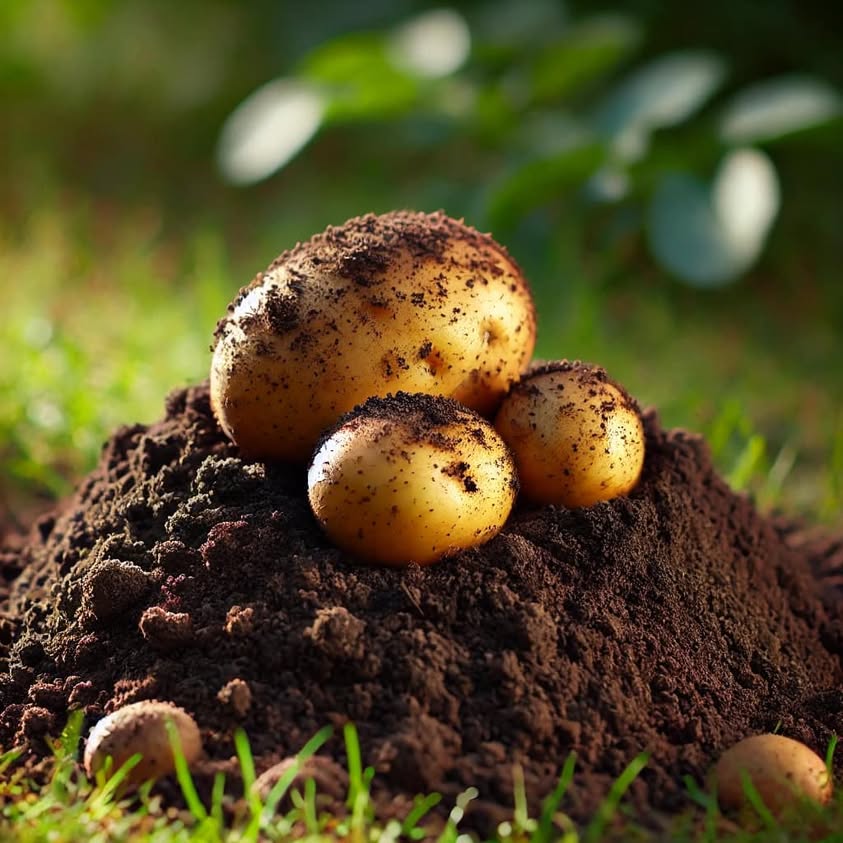
Every year, I tell myself, “This is it! This is the year I’m finally going to grow the perfect potatoes.” And every year, the potato gods laugh in my face.
It all started four years ago with what I thought was a foolproof method: the classic mound. I had read that potatoes prefer loose, well-drained soil, so I figured a little hill of soil would do the trick. I even added some organic matter to loosen up the heavy clay soil in that part of my garden. I was optimistic, thinking, “This year, my potatoes will have all the air and water they need.”
I diligently built my mounds, planted my seed potatoes, and then… waited. And waited. By midsummer, curiosity got the best of me, and I dug around to check on the progress. Instead of a bountiful harvest, I found a handful of tiny, stunted potatoes. They were so small they would’ve fit perfectly into a dollhouse kitchen. Apparently, my clay soil had decided to compact itself right back into a potato prison, organic matter or not. My neighbors politely declined my offer to share my “harvest,” and I resorted to making an extremely underwhelming potato salad that required more mayonnaise than actual potatoes. I told myself, “Hey, it’s a learning experience.”
The following year, I got more ambitious—or perhaps just more desperate. I decided to grow my potatoes in old tires. The idea was brilliant, or so I thought: start with one tire, plant the seed potatoes, and as the plants grow, just add another tire on top and fill it with a mix of soil and compost. It was like stacking rings for adults! This time, I was sure the loose, well-drained soil inside the tires would do the trick.
But as I added tire after tire, the potato plants didn’t seem to get the memo that they were supposed to grow taller. They just sat there, looking stumpy and confused, probably wondering why they were suddenly living in a rubber fortress. When it came time to harvest, I eagerly dismantled my tire tower, expecting a treasure trove of spuds. Instead, I found a few shriveled potatoes that looked like they’d been rejected by even the most desperate of leprechauns. It turns out my soil amendments hadn’t quite made up for the fact that the tires were more interested in turning into a compost heap than a potato haven.
Undeterred, the next year I moved on to wooden potato boxes. This was supposed to be the ultimate method. I built a sturdy box, planted my potatoes at the bottom, and as they grew, I added four-inch increments of soil, compost, and leaves along with wooden slats to make the box taller. This was going to be the year of the potato empire, I was sure of it.
But, as luck would have it, the potatoes decided to grow just enough to make it look like something was happening but not enough to produce anything substantial. When I finally opened up the box, I was greeted by the sight of a few scattered, mediocre potatoes sitting there like they were embarrassed to be seen. It was like the potato version of a middle school dance—awkward and disappointing. Even with all the organic matter I added, the heavy soil just couldn’t seem to loosen up enough for the potatoes to really spread out.
Fast forward to this year. I decided to go back to basics but with a twist: banked rows. I planted the seed potatoes in neat rows and then carefully banked soil, compost, and leaves against the plants as they grew taller. It was like tucking them in with a cozy soil blanket. I even worked in some cover crops the previous fall, letting the annual ryegrass decompose to give my potatoes the best start possible. I thought, “This time, it’s going to work. It has to!”
But guess what? The potatoes had other plans. I banked, they balked. I banked some more, they rebelled. It was as if they were taunting me, staying just out of reach and then producing, once again, a pathetic yield of spuds. Even with all the organic matter, compost, and cover crops, my potatoes seemed to have a personal vendetta against thriving in my garden.
So here I am, four years in, with nothing to show for it except a slightly bruised ego and a whole lot of potato-related frustration. But you know what? There’s always next year! And if that doesn’t work, well, there is always Food Basics.
Leave a Reply